|
 |
 |
 |
 |
 |
 |
 |
 |

 |
Methane Doesn't Necessarily Mean Life On Mars
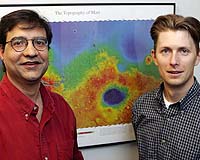
Dartmouth, UK (SPX) Jun 08, 2005 Two Dartmouth researchers have weighed in on the debate over whether the presence of methane gas on Mars indicates life on the red planet. Mukul Sharma, Assistant Professor of Earth Sciences, and Chris Oze, a postdoctoral fellow, argue that the Martian methane could have been produced by inorganic processes just as easily as by bacteria. In their paper published online in May in the American Geophysical Union's journal, Geophysical Research Letters, Sharma and Oze describe how methane on Mars can be made from abiotic, or non-living, sources. When water containing dissolved carbon dioxide comes in contact with olivine, it produces hydrogen, which then combines with carbon dioxide to produce methane. The authors contend that olivine is abundant on Mars at shallow depths, and it could easily react with fluids just beneath the surface. "Most methane on Earth is produced by bacteria, and methane has been cited as an indicator of life on other planets," explains Sharma. "However, we show in our paper that the mineral olivine can be altered in the presence of water and carbon dioxide, which can produce copious quantities of methane. It's quite easy to do, and there is nothing bacterial about it. If there is life on Mars, I would like to see better evidence than methane." The paper also provides a plausible explanation for a warmer and wetter early Mars. Recent results from rover missions on Mars have pointed to the presence of flowing water on the planet's surface. It is, however, impossible to heat the planet's surface to above freezing temperatures by greenhouse action of carbon dioxide alone. The authors estimate that the abiotic creation of methane via the altered olivine was very efficient due to a higher surface heat flow and more intense hydrothermal circulation. Sharma and Oze say that methane, a very effective greenhouse gas, would have been more abundant in the atmosphere resulting in a climate that was warm enough to allow liquid water to be present on the Martian surface. Community Email This Article Comment On This Article Related Links Dartmouth SpaceDaily Search SpaceDaily Subscribe To SpaceDaily Express Mars News and Information at MarsDaily.com Lunar Dreams and more
 Spirit Heading To 'Home Plate'
 Pasadena CA (JPL) Jan 09, 2006
Last week Spirit completed robotic-arm work on "El Dorado." The rover used all three of its spectrometers plus the microscopic imager for readings over the New Year's weekend. |
|
|

| The content herein, unless otherwise known to be public domain, are Copyright 1995-2006 - SpaceDaily.AFP and UPI Wire Stories are copyright Agence France-Presse and United Press International. ESA PortalReports are copyright European Space Agency. All NASA sourced material is public domain. Additionalcopyrights may apply in whole or part to other bona fide parties. Advertising does not imply endorsement,agreement or approval of any opinions, statements or information provided by SpaceDaily on any Web page published or hosted by SpaceDaily. Privacy Statement |