|
 |
 |
 |
 |
 |
 |
 |
 |

 |
Meteor Impacts: Life's Jump Starter?
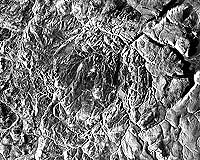
Devon Island, Canada (SPX) Aug 09, 2005 Meteor impacts are generally regarded as monstrous killers and one of the causes of mass extinctions throughout the history of life. But there is a chance the heavy bombardment of Earth by meteors during the planet's youth actually spurred early life on our planet, say Canadian geologists. A study of the Haughton Impact Crater on Devon Island, in the Canadian Arctic, has revealed some very life-friendly features at ground zero. These include hydrothermal systems, blasted rocks that are easier for microbes to inhabit, plus the cozy, protected basin created by the crater itself. If true, impact craters could represent some of the best sites to look for signs of past or present life on Mars and other planets. A presentation on the biological effects of impacts is scheduled for Monday, 8 August, at Earth System Processes 2, a meeting co-convened by the Geological Society of America and Geological Association of Canada this week in Calgary, Alberta, Canada. The idea that meteor impacts could benefit or even create conditions suitable for the beginning of early life struck Canadian Space Agency geologist Gordon Osinski while he and colleagues were conducting a geological survey of the 24-kilometer (15-mile) diameter Haughton Crater. Along the rim of the crater they noticed what looked like fossilized hydrothermal pipes, a few meters in diameter. "That set the bells ringing about possible biological implications," said Osinski. Hydrothermal systems are thought by many people to be the favourable places for life to evolve." Detailed mineralogical analyses have since revealed that when the Haughton meteor smacked into the icy ground 23 million years ago it created not only a crater, but fractured the ground in such a way as to create a system of steamy hydrothermal springs reaching temperatures of 250 degrees C. The heat appears to have gradually dropped over a period of tens of thousands of years, the researchers report. Besides providing heat and cracking the ground, the impact also created pore spaces in otherwise dense granitic rocks, giving microbes more access to the minerals and the surfaces inside the rocks - basically more real estate and more supplies. The shocked rocks are also more translucent, which would be beneficial to organisms that possessing with any photosynthetic capabilities. A crater shape itself also might serve as a protective environment, says Osinski. As such, impact craters are also good places to store evidence of past life. On Earth many craters fill with water and become lakes. Lakes accumulate sediments, the layers of which are a geological archive of the time after the crater formed. The Haughton Impact crater, for instance, contains the only Miocene-age sediments in the entire Canadian Arctic. "One of the most interesting aspects of the Haughton Impact Crater is that it's in a polar desert," said Osinski. The dry, frigid weather makes for a barren landscape that's easy to study, he said. The same features make it one of the more Mars-like places on Earth. "Most people put impacts with mass extinctions," said Osinski. "What we're trying to say is that following the impact, the impact sites are actually more favorable to life than the surrounding terrain." It's interesting to note, says Osinski, that on Earth the heaviest meteor bombardment of the planet happened at about the same time as life is believed to have started: around 3.8 billion years ago. Impact craters of that age were long ago erased on Earth by erosion, volcanic resurfacing and plate tectonics. But other planets and moons - including Mars - still bear the cosmic scars of that early debris-clogged period in the solar system. It may be possible, therefore, that the best places to look for at least fossil evidence of life on Mars is inside those very same craters, he said. "What we're doing is trying to narrow down the search area," said Osinski. Community Email This Article Comment On This Article Related Links Geological Society of America SpaceDaily Search SpaceDaily Subscribe To SpaceDaily Express Explore The Early Earth at TerraDaily.com
 Oxygen in Ancient Atmosphere Rose Gradually To Modern Levels
 College Park MD (SPX) Dec 03, 2005
The history of life on Earth is closely linked to the appearance of oxygen in the atmosphere. The current scientific consensus holds that significant amounts of oxygen first appeared in Earth's atmosphere some 2.4 billion years ago, with a second large increase in atmospheric oxygen occurring much later, perhaps around 600 million years ago. |
|
|

| The content herein, unless otherwise known to be public domain, are Copyright 1995-2006 - SpaceDaily.AFP and UPI Wire Stories are copyright Agence France-Presse and United Press International. ESA PortalReports are copyright European Space Agency. All NASA sourced material is public domain. Additionalcopyrights may apply in whole or part to other bona fide parties. Advertising does not imply endorsement,agreement or approval of any opinions, statements or information provided by SpaceDaily on any Web page published or hosted by SpaceDaily. Privacy Statement |