|
 |
 |
 |
 |
 |
 |
 |
 |

 |
Meteor Dust Could Affect Climate, Study Suggests
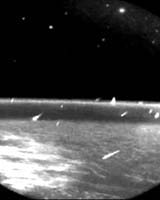
Paris (AFP) Aug 24, 2005 A space boulder that disintegrated in a fiery descent over Antarctica last year has sparked a theory that meteor dust may play a hidden role in our climate system. The rock, estimated at 1,000 tonnes, entered the upper atmosphere above Antarctica last September 3, becoming a fireball spotted by the infrared eyes of US defence satellites, a study published on Thursday says. Friction with air molecules stripped away the rock, transforming it into a cloud of dust that trailed from 56 to 18 kilometers (35 to 11 miles) in altitude. The rock was consumed in the plunge. Closer inspection of the lingering cloud, using instruments at an Antarctic ground station, suggests its particles were as large as 20 microns (20 millionths of a metre) -- around a thousand times bigger than previous estimates for the size of meteor debris. The finding is significant, because large quantities of dust are dumped in Earth's atmosphere from tiny pieces of asteroid rubble or debris left by passing comets, although no-one knows for sure how much is deposited. Previous research has already shown that particles which are larger than one micron, spewed out by volcanoes, can play a crucial role in affecting weather. Their relatively large size helps them to reflect the Sun's rays, thus creating a local cooling effect, and also provides a nucleus for attracting atmospheric moisture -- they encourage clouds to form. In addition, large particles tend to linger longest in the atmosphere, sometimes taking months to reach the planet's surface. Space dust is mostly deposited by rubble that is consumed in the fiery descent. To the human eye, the event is visible as a reddish-golden streak, a meteor, that may also leave a smoke-like trail. Larger objects may partly survive the collision with the atmosphere. Their remains -- called meteorites -- can amount for between one and 25 percent of the original rock, as the rest of the mineral is ablated away by atmospheric friction. Very big rocks, mercifully rare, can explode with catastrophic force if they collide with Earth. The long reign of the dinosaurs is believed to have been ended by a large asteroid or comet that smacked into the globe some 65 million years ago in modern-day Mexico. The study, published in the British science journal Nature, was led by Andrew Klekociuk of the Australian Antarctic Division, based in Kingston, Tasmania. Community Email This Article Comment On This Article Related Links SpaceDaily Search SpaceDaily Subscribe To SpaceDaily Express Climate Science News - Modeling, Mitigation Adaptation
 The Forgotten Methane Source
 Heidelberg, Germany (SPX) Jan 11, 2006
In the last few years, more and more research has focused on the biosphere; particularly, on how gases which influence the climate are exchanged between the biosphere and atmosphere. Researchers from the Max Planck Institute for Nuclear Physics have now carefully analysed which organic gases are emitted from plants. |
|
|

| The content herein, unless otherwise known to be public domain, are Copyright 1995-2006 - SpaceDaily.AFP and UPI Wire Stories are copyright Agence France-Presse and United Press International. ESA PortalReports are copyright European Space Agency. All NASA sourced material is public domain. Additionalcopyrights may apply in whole or part to other bona fide parties. Advertising does not imply endorsement,agreement or approval of any opinions, statements or information provided by SpaceDaily on any Web page published or hosted by SpaceDaily. Privacy Statement |