|
 |
 |
 |
 |
 |
 |
 |
 |

 |
Metamaterials Found To Work For Visible Light
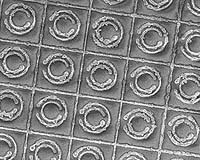
Ames IO (SPX) Jan 09, 2007 For the first time ever, researchers at the U.S. Department of Energy's Ames Laboratory have developed a material with a negative refractive index for visible light. Ames Laboratory senior physicist Costas Soukoulis, working with colleagues in Karlsruhe, Germany, designed a silver-based, mesh-like material that marks the latest advance in the rapidly evolving field of metamaterials, materials that could lead to a wide range of new applications as varied as ultrahigh-resolution imaging systems and cloaking devices. The discovery, detailed in the Jan. 5 issue of Science and the Jan. 1 issue of Optic Letters, and noted in the journal Nature, marks a significant step forward from existing metamaterials that operate in the microwave or far infrared - but still invisible -regions of the spectrum. Those materials, announced this past summer, were heralded as the first step in creating an invisibility cloak. Metamaterials, also known as left-handed materials, are exotic, artificially created materials that provide optical properties not found in natural materials. Natural materials refract light, or electromagnetic radiation, to the right of the incident beam at different angles and speeds. However, metamaterials make it possible to refract light to the left, or at a negative angle. This backward-bending characteristic provides scientists the ability to control light similar to the way they use semiconductors to control electricity, which opens a wide range of potential applications. "Left-handed materials may one day lead to the development of a type of flat superlens that operates in the visible spectrum," said Soukoulis, who is also an Iowa State University Distinguished Professor of Liberal Arts and Sciences. "Such a lens would offer superior resolution over conventional technology, capturing details much smaller than one wavelength of light to vastly improve imaging for materials or biomedical applications," such as giving researchers the power to see inside a human cell or diagnose disease in a baby still in the womb. The challenge that Soukoulis and other scientists who work with metamaterials face is to fabricate them so that they refract light at ever smaller wavelengths. The "fishnet" design developed by Soukoulis' group and produced by researchers Stefan Linden and Martin Wegener at the University of Karlsruhe was made by etching an array of holes into layers of silver and magnesium fluoride on a glass substrate. The holes are roughly 100 nanometers wide. For some perspective, a human hair is about 100,000 nanometers in diameter. "We have fabricated for the first time a negative-index metamaterial with a refractive index of -0.6 at the red end of the visible spectrum (wavelength 780 nm)," said Soukoulis. "This is the smallest wavelength obtained so far." While the silver used in the fishnet material offers less resistance when subjected to electromagnetic radiation than the gold used in earlier materials, energy loss is still a major limiting factor. The difficulties in manufacturing materials at such a small scale also limit the attempts to harness light at ever smaller wavelengths. "Right now, the materials we can build at THz and optical wavelengths operate in only one direction," Soukoulis said, "but we've still come a long ways in the six years since negative-index materials were first demonstrated." "However, for applications to come within reach, several goals need to be achieved," he added. "First, reduction of losses by using crystalline metals and/or by introducing optically amplifying materials; developing three-dimensional isotropic designs rather than planar structures; and finding ways of mass producing large-area structures." The Basic Energy Sciences Office of the DOE's Office of Science funds Ames Laboratory's research on metamaterials. Ames Laboratory, which is celebrating its 60th anniversary in 2007, is operated for the Department of Energy by Iowa State University. The Lab conducts research into various areas of national concern, including energy resources, high-speed computer design, environmental cleanup and restoration, and the synthesis and study of new materials. Community Email This Article Comment On This Article Related Links Ames Laboratory Powering The World in the 21st Century at Energy-Daily.com Space Technology News - Applications and Research
 Researchers Use Wikipedia To Make Computers Smarter
 Tel-Aviv, Israel (SPX) Jan 10, 2007
Researchers at the Technion-Israel Institute of Technology have found a way to give computers encyclopedic knowledge of the world to help them "think smarter," making common sense and broad-based connections between topics just as the human mind does. |
|
|

| The content herein, unless otherwise known to be public domain, are Copyright 1995-2006 - SpaceDaily.AFP and UPI Wire Stories are copyright Agence France-Presse and United Press International. ESA PortalReports are copyright European Space Agency. All NASA sourced material is public domain. Additionalcopyrights may apply in whole or part to other bona fide parties. Advertising does not imply endorsement,agreement or approval of any opinions, statements or information provided by SpaceDaily on any Web page published or hosted by SpaceDaily. Privacy Statement |