|
 |
 |
 |
 |
 |
 |
 |
 |

 |
Messenger Shipped to Goddard for Prelaunch Tests
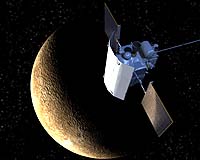
Greenbelt - Dec 22, 2003 Less than six months from its scheduled launch to Mercury, Messenger is set for the next round of tests to prepare it for the first orbital study of the innermost planet. Messenger was shipped today from the Johns Hopkins University Applied Physics Laboratory (APL) in Laurel, Md. - where it was designed and built - to the environmental testing facilities at NASA's Goddard Space Flight Center in Greenbelt, Md. The 20-mile delivery capped nearly four years of detailed design, assembly and testing on one of the most complex spacecraft APL has ever built. With features ranging from a lightweight composite structure and miniaturized instruments to a heat-radiation system and protective ceramic-fabric sunshade, Messenger is well equipped for a 5-year cruise through the inner solar system and a yearlong study of Mercury starting in July 2009. "We're sending a spacecraft to orbit a planet where the sun is 11 times brighter than what we see on Earth and temperatures can climb past 800 degrees Fahrenheit," says Messenger Project Manager David G. Grant, of APL. "This is an incredible engineering and scientific challenge that no one has ever tried before, and the team is doing all it can on the ground to make sure Messenger succeeds at Mercury." This week engineers finished the first of Messenger's "shake and bake" tests, checking the spacecraft's structural strength atop large vibration tables at APL. Over the next 10 weeks at Goddard the team will check Messenger's balance and alignment; put it before speakers that simulate the noise-induced vibrations of launch; and seal it in a large thermal-vacuum chamber that duplicates the extreme heat, cold and airless conditions of space. In March, Messenger will be sent to Kennedy Space Center/Cape Canaveral Air Force Station, Fla., and prepared for its May 2004 launch aboard a Boeing Delta II rocket. "Each part of the spacecraft has passed individual vibration and environmental tests, and under tougher conditions than we expect they will see at Mercury," says James C. Leary, Messenger mission systems engineer at APL. "Now we're looking at Messenger as a whole system. By the time it launches Messenger will have been thoroughly tested." Carrying seven scientific instruments - including a camera, laser altimeter, magnetometer and several spectrometers - the solar- powered Messenger will image Mercury globally for the first time. It also will gather data on the composition and structure of Mercury's crust, its geologic history, the nature of its thin atmosphere and active magnetosphere, and the makeup of its core and polar materials. While cruising to Mercury the spacecraft will fly past the planet twice - in 2007 and 2008 - snapping pictures and gathering data critical to planning the orbit study. Sean C. Solomon of the Carnegie Institution of Washington leads Messenger (MErcury Surface, Space Environment, Geochemistry, and Ranging) as principal investigator; the Applied Physics Laboratory manages the mission for NASA's Office of Space Science and will operate the spacecraft. GenCorp Aerojet, Sacramento, Calif., and Composite Optics Inc., San Diego, provided Messenger's propulsion system and composite structure, respectively. APL, Goddard Space Flight Center, University of Michigan, Ann Arbor, and University of Colorado, Boulder, built the spacecraft's scientific instruments. Community Email This Article Comment On This Article Related Links Messenger at APL SpaceDaily Search SpaceDaily Subscribe To SpaceDaily Express Astronomy News from Skynightly.com
 Chris Van Allsburg Talks About Sci-Fi, Art And Education
 Washington DC (SPX) Nov 21, 2005
NASA is part of a partnership that provides educational materials based on the book and movie "Zathura" to help teachers get students excited about space and learning. |
|
|

| The content herein, unless otherwise known to be public domain, are Copyright 1995-2006 - SpaceDaily.AFP and UPI Wire Stories are copyright Agence France-Presse and United Press International. ESA PortalReports are copyright European Space Agency. All NASA sourced material is public domain. Additionalcopyrights may apply in whole or part to other bona fide parties. Advertising does not imply endorsement,agreement or approval of any opinions, statements or information provided by SpaceDaily on any Web page published or hosted by SpaceDaily. Privacy Statement |