|
 |
 |
 |
 |
 |
 |
 |
 |

 |
Messenger Out Of The Bottle
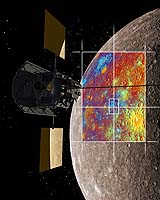
Moffett Field CA (SPX) Apr 20, 2005 The Messenger spacecraft launched on August 3, 2004, and after flybys of Earth, Venus and Mercury, will start a yearlong study of its target Mercury in March 2011. Messenger is about 85.9 million miles (138.2 million kilometers) from the Sun and 23.1 million miles (37.3 million kilometers) from Earth. At that distance, a signal from Earth reaches the spacecraft in 2 minutes, 4 seconds. The spacecraft is moving around the Sun at 71,869 miles (115,662 kilometers) per hour. Messenger's onboard computers have executed 37,887 commands from mission operators since launch on Aug 2, 2004. The Messenger probe took off last summer on its decade long tour of the inner solar system to orbit Mercury. The mission operations and spacecraft teams continue to check out Messenger's science payload - and prepare for additional instrument operations in the weeks ahead. The team checked and commissioned the Energetic Particle and Plasma Spectrometer (EPPS) instrument over the past week. On April 8 they wrapped up a two-day look at the EPPS Fast Imaging Plasma Spectrometer (FIPS) element, during which they carefully and gradually turned it up to its highest operating voltage. Then the team moved on to a similar test with the EPPS Energetic Particle Spectrometer component, ending it successfully on April 13. The X-Ray Spectrometer underwent a full functional test on April 14. More activity for FIPS on April 15, observing the solar wind for an hour while spacecraft operators watched Messenger's power levels and temperatures around the propellant tanks and rear antenna. "We're not like Cassini, going out where it's nice and cool," said Robert Strom, Messenger co-Investigator from the University of Arizona in Tucson. "Orbiters of Mars and Jupiter and Saturn, they're kind of orbiting paradise compared to Messenger, which is going to orbit hell. But it's a very interesting hell." Because Mercury is so close to the sun, its surface temperature can exceed 450 degrees Celsius (840 degrees Fahrenheit). But Mercury is not uniformly hot, because the thin atmosphere does not transfer heat from the equator to the poles. Temperatures on the dark side of the planet can drop to -185 degrees C (-300 degrees F). Messenger carries seven scientific instruments that will provide images of the entire planet, as well as information on the composition of Mercury's crust, core, and polar materials, its geologic history, and the nature of its thin atmosphere and active magnetosphere. "The mystery is why has tiny Mercury retained a magnetic field, when larger planets in the inner solar system - Mars and Venus - do not have a global magnetic field today," says Solomon. Mercury is about the size of our moon, and extremely dense. The planet's density is so high that two-thirds of the planet is believed to be iron metal. For this reason, Mercury's surface gravity is about the same as the surface gravity of Mars. Scientists aren't sure why Mercury is so dense. Perhaps there was a gradient in chemistry of the solar disk of gas and dust that formed the planets, with more metal closer to the sun. Solomon says that if Mercury's high iron composition is due to a solar nebula gradient, then the silicate material at Mercury's surface should have the major elements in approximately solar proportions. Another possibility is that Mercury's composition was Earth-like to start, but the heat from the sun caused Mercury to lose its rocky material. If so, then the surface will have relatively less of the more easily vaporized materials. When Mariner 10 flew by Mercury in 1974 and 1975, it took pictures of less than half of the planet's surface. Still, these images allowed scientists to see Mercury's surface close-up, revealing a moon-like landscape dotted with craters. Mariner images also showed large-scale faulting on the planet's surface. Scarps scattered randomly over the hemisphere are a result of the crust buckling, and suggest that the planet has shrunk from its original size. "That seems a little crazy at first, but when you think about it, as the core cooled, when it goes from a liquid to a solid there's going to be a volume change," says Mark Robinson, Messenger investigator from Northwestern University. "If the crust had already formed when that happened, as the planet shrank, that tension had to be taken up somewhere, and buckling of the crust made these large scarps." Overall the spacecraft is in good health and operating normally. Dr. Sean C. Solomon, of the Carnegie Institution of Washington, leads the mission as principal investigator. Community Email This Article Comment On This Article Related Links University of Arizona in Tucson Messenger mission at John Hopkins University SpaceDaily Search SpaceDaily Subscribe To SpaceDaily Express Astronomy News from Skynightly.com
 Chris Van Allsburg Talks About Sci-Fi, Art And Education
 Washington DC (SPX) Nov 21, 2005
NASA is part of a partnership that provides educational materials based on the book and movie "Zathura" to help teachers get students excited about space and learning. |
|
|

| The content herein, unless otherwise known to be public domain, are Copyright 1995-2006 - SpaceDaily.AFP and UPI Wire Stories are copyright Agence France-Presse and United Press International. ESA PortalReports are copyright European Space Agency. All NASA sourced material is public domain. Additionalcopyrights may apply in whole or part to other bona fide parties. Advertising does not imply endorsement,agreement or approval of any opinions, statements or information provided by SpaceDaily on any Web page published or hosted by SpaceDaily. Privacy Statement |