|
 |
 |
 |
 |
 |
 |
 |
 |

 |
Merkel To Improve U.S.-German Ties
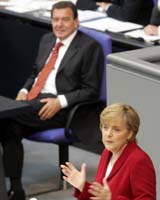
Kehl Am Rhein, Germany (UPI) Nov 15, 2005 The new German government has vowed to improve relations with the United States, though not for the sake of a "self-confident Europe." Soon-to-be Chancellor Angela Merkel in her campaign promised to improve ties with the United States in a bid to repair damage done in recent years by Gerhard Schroeder. The outgoing German chancellor teamed up with President Jacques Chirac of France to become one of the fiercest critics of the U.S.-led war in Iraq. During the conflict, already cool relations became icy, and observers say they have never fully warmed again. But Schroeder is set to step aside and free the way for Merkel, who is expected to make a different imprint on Germany's foreign policy agenda. Her government of conservatives and Social Democrats was approved Monday by the main parties, which separately endorsed the 140-page coalition treaty. Apart from painful agreements to raise taxes and save roughly $40 billion in the country's budget, the deal said the government will seek to improve ties with Washington and promote better understanding between the United States and Europe. There are a few issues still to be solved, however, such as finding a common policy toward the weapons embargo on China and a solution to the conflict between Boeing and Airbus. "We want to shape trans-Atlantic relations that are oriented toward the future without forgetting our common history," the text said. "To do that, it is essential to have a close relationship of trust between the United States and a self-confident Europe that sees itself not as a counterweight, but as a partner. That doesn't exclude the possibility of differences of opinion which have to be dealt with through partnership-like dialogue and in a spirit of friendship." While the new government seems to have changed the tone, there will be continuity in the content of German foreign policy, Jens van Scherpenberg, trans-Atlantic relations expert at the German Institute for International and Security Affairs, a Berlin-based think tank, on Tuesday told United Press International in a telephone interview. "The new coalition obviously included the implicit confession that the last German government spoke too tartly at times," van Scherpenberg said in reference to the last sentence of the excerpt above. "For the large part, however, the text implicates continuity, meaning that the trans-Atlantic friendship is based on a self-confident Europe. Focusing on 'partnership' is on the one hand a sign for close cooperation, but on the other hand a clear 'no' to U.S. unilateralism." Washington had hoped that Merkel's conservatives would form a government with the free-market and largely pro-U.S. Free Democratic Party. Germany's Sept. 18 inconclusive elections, however, had neither party gain a clear majority, which led to the formation of a grand coalition, the first such alliance since the late 1960s. Washington likely didn't jump for joy over the nomination of Frank-Walter Steinmeier as new foreign minister. Steinmeier was Schroeder's former right-hand man; he has headed the chancellery since 1999 and backed the policy of condemning Bush's attack on Iraq. Jan-Friedrich Kallmorgen, trans-Atlantic expert at the German Council on Foreign Relations and director of the Atlantic Initiative, a new think tank in Berlin, Tuesday told UPI in a telephone interview that emphasizing Europe's role as a partner and not a "counterweight" will likely be "soothing to many ears in Washington." And despite what he called a "very broadly formulated coalition text," Kallmorgen expects the US-German relations to improve. "Merkel is much more U.S.-friendly than Schroeder was," he said. "She wants to move Germany back into the role of a balancing force within Europe. I don't think that another diplomatic fallout can happen between Berlin and Washington." The text also sets the goal of "improving the resolution of trade disputes," which could be crucial to German-American ties, van Scherpenberg said. The United States and Europe are close trade partners, with German companies exporting heavily into the North American market. There have been a few minor quarrels over agricultural funding and free trade, but the big issue that has officials on both sides of the Atlantic worry is the ongoing conflict between U.S. giants Boeing and Airbus, which is owned by Franco-German firm European Aeronautic, Defense & Space, or EADS. Both corporations are active in key strategic industries, both secure large amounts of domestic jobs. The United States has challenged government aid for Airbus from Germany, Britain, France and Spain. The EU in turn has complained U.S. state and local authorities provide assistance for Boeing. The case will soon be handled by the World Trade Organization, in what is considered the body's most difficult case yet. "The WTO likely won't be able to solve this issue, and it shouldn't," van Scherpenberg said. "I am for solving this problem bilaterally. If Berlin and Washington could find a creative agreement, then that would have important political implications and tremendously boost the trans-Atlantic friendship," he said. Such a solution could be an agreement to -- over the next 15 years -- gradually do away with government assistance, if one was to agree on what exactly was aid and what was not, he said. The text also notes that together with the United States, Berlin wanted to "stand up for peace, democracy and freedom in the world," and later adds Germany wanted to support "movements of democracy and modernization in the Arab world." It lacks, however, a position toward the Chinese weapons embargo. The issue head created a rift between Berlin and Washington after Schroeder launched an -- albeit unsuccessful -- try to get the arms ban lifted. Van Scherpenberg said while the EU would benefit from better relations with China, the United States is using the issue as a make-or-break deal over trans-Atlantic ties. Large parts of the U.S. Congress fiercely oppose lifting the ban. "That could be the next big problem," he said. Kallmorgen, however, said Merkel will likely listen closely to Washington's arguments concerning regional and global security questions, with the Pentagon likely continuing its diplomatic approach of Europe, if only for reasons of self-interest. "(President George W.) Bush is under enormous pressure," Kollhagen said, citing the CIA scandal at home and the growing unease over U.S. involvement in Iraq. "The last thing this administration needs is another international diplomatic conflict." Community Email This Article Comment On This Article Related Links SpaceDaily Search SpaceDaily Subscribe To SpaceDaily Express
 The EUs Grim Year
 Washington (UPI) Jan 05, 2006
After a grim year of slow growth, riots and terror attacks from its Muslim immigrant underclass, rows over its budget and two thumping rejections by Dutch and French voters of its planned new constitution, the European Union's leaders can hardly wait for 2005 to be over to make a fresh start in the New Year. |
|
|

| The content herein, unless otherwise known to be public domain, are Copyright 1995-2006 - SpaceDaily.AFP and UPI Wire Stories are copyright Agence France-Presse and United Press International. ESA PortalReports are copyright European Space Agency. All NASA sourced material is public domain. Additionalcopyrights may apply in whole or part to other bona fide parties. Advertising does not imply endorsement,agreement or approval of any opinions, statements or information provided by SpaceDaily on any Web page published or hosted by SpaceDaily. Privacy Statement |