|
 |
 |
 |
 |
 |
 |
 |
 |

 |
Mercury Atomic Clock Keeps Time With Record Accuracy
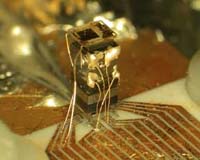
Gaithersburg, MD (SPX) Jul 18, 2006 An experimental atomic clock based on a single mercury atom is now at least five times more precise than the national standard clock based on a "fountain" of cesium atoms, according to a paper by physicists at the Commerce Department's National Institute of Standards and Technology (NIST) in the July 14 issue of Physical Review Letters. The experimental clock, which measures the oscillations of a mercury ion (an electrically charged atom) held in an ultra-cold electromagnetic trap, produces "ticks" at optical frequencies. Optical frequencies are much higher than the microwave frequencies measured in cesium atoms in NIST-F1, the national standard and one of the world's most accurate clocks. Higher frequencies allow time to be divided into smaller units, which increases precision. A prototype mercury optical clock was originally demonstrated at NIST in 2000. Over the last five years its absolute frequency has been measured repeatedly with respect to NIST-F1. The improved version of the mercury clock is the most accurate to date of any atomic clock, including a variety of experimental optical clocks using different atoms and designs. The current version of NIST-F1--if it were operated continuously--would neither gain nor lose a second in about 70 million years. The latest version of the mercury clock would neither gain nor lose a second in about 400 million years. "We finally have addressed the issue of systemic perturbations in the mercury clock. They can be controlled, and we know their uncertainties," says NIST physicist Jim Bergquist, the principal investigator. "By measuring its frequency with respect to the primary standard, NIST-F1, we have been able to realize the most accurate absolute measurement of an optical frequency to date. And in the latest measurement, we have also established that the accuracy of the mercury-ion system is at a level superior to that of the best cesium clocks." Improved time and frequency standards have many applications. For instance, ultra-precise clocks can be used to improve synchronization in navigation and positioning systems, telecommunications networks, and wireless and deep-space communications. Better frequency standards can be used to improve probes of magnetic and gravitational fields for security and medical applications, and to measure whether "fundamental constants" used in scientific research might be varying over time--a question that has enormous implications for understanding the origins and ultimate fate of the universe. Scientists have long recognized that optical atomic clocks could be more stable and accurate than cesium microwave clocks, which have kept world time for more than 50 years. Even with the latest results at NIST, however, optical clocks based on mercury, strontium or other atoms remain a long way from being accepted as standards. Research groups around the world would first need to agree on an atom and clock design to be used internationally. In addition, a system of additional optical clocks would be needed to continuously keep time, because primary standard clocks--such as the mercury ion or other future optical standard--are generally operated only periodically for calibrations. NIST-F1, for instance, is operated several times a year for periods of about one month to calibrate the frequencies of several NIST microwave atomic clocks that continuously track current time. These clocks contribute to an international group of atomic clocks that define the official world time. Community Email This Article Comment On This Article Related Links National Institute of Standards and Technology Understanding Time and Space
 British Physics Labs To Merge
 Swindon, England (SPX) Jul 28, 2006
The Department of Trade and Industry announced Tuesday that the U.K. government has decided to create a new Large Facilities Council merging the Council for the Central Laboratory of the Research Councils and the Particle Physics and Astronomy Research Council following the Next Steps consultation exercise. |
|
|

| The content herein, unless otherwise known to be public domain, are Copyright 1995-2006 - SpaceDaily.AFP and UPI Wire Stories are copyright Agence France-Presse and United Press International. ESA PortalReports are copyright European Space Agency. All NASA sourced material is public domain. Additionalcopyrights may apply in whole or part to other bona fide parties. Advertising does not imply endorsement,agreement or approval of any opinions, statements or information provided by SpaceDaily on any Web page published or hosted by SpaceDaily. Privacy Statement |