|
 |
 |
 |
 |
 |
 |
 |
 |

 |
Memory Design Breakthrough Can Lead To Faster Computers
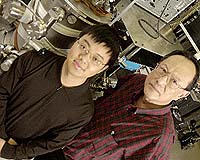
Baltimore MD (SPX) Jan 16, 2006 Imagine a computer that doesn't lose data even in a sudden power outage, or a coin-sized hard drive that could store 100 or more movies. Magnetic random-access memory, or MRAM, could make these possible, and would also offer numerous other advantages. It would, for instance, operate at much faster than the speed of ordinary memory but consume 99 percent less energy. The current challenge, however, is the design of a fast, reliable and inexpensive way to build stable and densely packed magnetic memory cells. A team of researchers at The Johns Hopkins University, writing in the Jan. 13 issue of Physical Review Letters, has come up with one possible answer: tiny, irregularly shaped cobalt or nickel rings that can serve as memory cells. These "nanorings" can store a great quantity of information. They also are immune to the problem of "stray" magnetic fields, which are fields that "leak" from other kinds of magnets and can thus interfere with magnets next to them. "It's the asymmetrical design that's the breakthrough, but we are also very excited about the fast, efficient and inexpensive method we came up with for making them," said paper co-author Frank Q. Zhu, a doctoral candidate in the Henry A. Rowland Department of Physics and Astronomy in the Krieger School of Arts and Sciences at Johns Hopkins. The nanorings are extremely small, with a diameter of about 100 nanometers. A single nanometer is one billionth of a meter. A single strand of human hair can hold 1 million rings of this size, Zhu says. The asymmetrical design allows more of the nanorings to end up in a so-called "vortex state," meaning they have no stray field at all. With no stray field to contend with, Zhu's team's nanorings act like quiet neighbors who don't bother each other and, thus, can be packed together extremely densely. As a result, the amount of information that can be stored in a given area is greatly increased. Fabrication of the nanorings is a multistep procedure involving self-assembly, thin film deposition and dry etching. The key to creating the irregular rings, Zhu said, is to -- while etching the rings with an argon ion beam at the end of the process -- tilt the substrate on which the rings are formed. "In our previous study, we found that 100 nanometer symmetric nanorings have only about a 40 percent chance to get vortex state," Zhu said. "But the asymmetric nanorings have between a 40 percent and 100 percent chance to get vortex state. This chance can be controlled on-demand by utilizing the direction of magnetic field." The research is funded by the National Science Foundation. The Physical Review Letters paper will be available online Jan. 12 here. Community Email This Article Comment On This Article Related Links Johns Hopkins University SpaceDaily Search SpaceDaily Subscribe To SpaceDaily Express Space Technology News - Applications and Research
 Worldwide Market For Digital Radio To Increase To 22M Units By 2009: R&M
 Dublin, Ireland (SPX) Jan 16, 2006
Research and Markets has announced the addition of Digital Radio: Turning Up the Volume on Satellite and Terrestrial Radio Adoption to their offering. |
|
|

| The content herein, unless otherwise known to be public domain, are Copyright 1995-2006 - SpaceDaily.AFP and UPI Wire Stories are copyright Agence France-Presse and United Press International. ESA PortalReports are copyright European Space Agency. All NASA sourced material is public domain. Additionalcopyrights may apply in whole or part to other bona fide parties. Advertising does not imply endorsement,agreement or approval of any opinions, statements or information provided by SpaceDaily on any Web page published or hosted by SpaceDaily. Privacy Statement |