
 |
 |
 |
 |
 |
 |
 |
 |
 |

 |
Medvedev takes control of Russian nuclear arsenal
Moscow (AFP) May 7, 2008 Newly inaugurated President Dmitry Medvedev on Wednesday formally assumed control of Russia's nuclear arsenal at a Kremlin meeting in which a military officer brought him a black nuclear briefcase. Medvedev, who was sworn in to succeed Vladimir Putin earlier, took command in the presence of Defence Minister Anatoly Serdyukov at a sombre meeting that contrasted with his glittering inauguration ceremony. "Comrade commander-in-chief! Allow me to give you control of the strategic forces of the country," said the officer carrying the nuclear briefcase, in images shown on state television. The nuclear briefcase, a symbol of political power in Russia since the Cold War, is shrouded in secrecy but believed to contain a small computer with activation codes for nuclear missiles. Russia's first post-Soviet president, Boris Yeltsin, reportedly came close to using the briefcase in January 1995 when a research rocket launched from Norway activated Russia's early warning system. The briefcase was developed during the Cold War when it became clear that early warning of a nuclear attack would only give Soviet leaders a few minutes to retaliate -- too little time to travel to a central command centre. Russia is currently estimated to have around 20,000 nuclear weapons. Community Email This Article Comment On This Article Share This Article With Planet Earth
Related Links Learn about nuclear weapons doctrine and defense at SpaceWar.com Learn about missile defense at SpaceWar.com All about missiles at SpaceWar.com Learn about the Superpowers of the 21st Century at SpaceWar.com
 India tests ballistic missile capable of reaching China
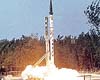 Bhubaneswar, India (AFP) May 7, 2008
India successfully tested a nuclear-capable missile Wednesday that can hit targets deep inside China, joining the ranks of nations possessing intermediate-range missile capacity, the defence ministry said. |
|
|

| The content herein, unless otherwise known to be public domain, are Copyright 1995-2007 - SpaceDaily.AFP and UPI Wire Stories are copyright Agence France-Presse and United Press International. ESA Portal Reports are copyright European Space Agency. All NASA sourced material is public domain. Additional copyrights may apply in whole or part to other bona fide parties. Advertising does not imply endorsement,agreement or approval of any opinions, statements or information provided by SpaceDaily on any Web page published or hosted by SpaceDaily. Privacy Statement |
 del.icio.us
 Digg
Digg Reddit
 YahooMyWeb
 Google
 Facebook