|
 |
 |
 |
 |
 |
 |
 |
 |

 |
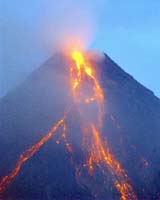
Mayon Is The Philippines' Most Active Volcano
Manila (AFP) Aug 07, 2006 The Mayon volcano, with its symmetrical cone, is the most active volcano in the Philippines. Towering 8,070 feet (2,460 meters) above the central city of Legaspi, it is a popular tourist attraction considered by many to be more beautiful than Mount Fuji in Japan. Just 350 kilometres (217 miles) southeast of Manila, it has erupted 47 times since 1616. The most destructive was on February 1, 1814, when lava flows buried the town of Cagsawa killing 1,200 people. The belltower of the town's church is all that remains of the once bustling farming center. The most recent deadly eruption occurred in 1993 and lasted 30 minutes. The lava flows that followed killed 68 people and prompted the evacuation of 60,000 others. A popular tourist attraction, Mayon is surrounded by local myths and legends. One of the most popular is the Romeo and Juliet story of a beautiful native princess and her possessive uncle named Magayon. Her uncle was said to be so possessive of his niece that no man dared go near her. One warrior, however, was so smitten by her beauty he ignored all warnings, climbed through the window of the royal chamber and enticed the princess to elope with him. With Magayon in hot pursuit the couple prayed to the gods for help. Out of nowhere, a landslide buried the uncle alive. Locals say that Mayon's eruptions is Magayon's anger bursting forth. But in reality it is a quirk of geography that condemns most of the Philippines to live under perpetual threat of earthquakes, volcanic eruptions and potential tsunamis, courtesy of the undersea Pacific Ocean plate. The archipelago is part of the Pacific "Ring of Fire", an arc of islands that encompasses New Zealand, the eastern edge of Asia, Alaska's Aleutian Islands and through the west coast of North and South America. The area is constantly rocked by the undersea Pacific plate's constant clash with surrounding plates, leading to earth tremors and melting rock that push out to the surface as volcanic lava. The Philippine archipelago, with the exception of the western island of Palawan, is hit by at least 20 earthquakes a day, though only a few are felt by humans, said Renato Solidum, head of the Philippine Institute of Volcanology and Seismology. Deadly quakes occur every three or four years. Mayon, on the Bicol peninsula of the main island of Luzon, is one of 22 Philippine volcanoes that have erupted within recorded history. It is one of six where the institute has installed permanent monitoring stations and equipment. One of the deadliest recorded eruptions in the Philippines occurred less than 100 kilometers (62 miles) north of Manila in June 1991, when the long-dormant Pinatubo volcano blew off its top, killing more than a thousand people. Millions of tons of sulfur dioxide shot into the stratosphere blocked sunlight and cooled the entire Earth by up to 0.6 degrees Celsius for years afterwards, scientists said.
Source: Agence France-Presse Community Email This Article Comment On This Article Related Links Bring Order To A World Of Disasters Bringing Order To A World Of Disasters When the Earth Quakes A world of storm and tempest
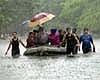
 India Steps Up Relief Efforts As Floods Hit Hundreds Of Thousands
 Mumbai (AFP) Aug 07, 2006
Fifty-five people were reported killed by flooding in India as relief workers Monday moved thousands marooned by heavy monsoon rains to higher ground. Authorities raced to shift some 30,000 people when the city of Surat in the western coastal state of Gujarat was flooded after the Tapti river burst its banks, local officials said. |
|
|

| The content herein, unless otherwise known to be public domain, are Copyright 1995-2006 - SpaceDaily.AFP and UPI Wire Stories are copyright Agence France-Presse and United Press International. ESA PortalReports are copyright European Space Agency. All NASA sourced material is public domain. Additionalcopyrights may apply in whole or part to other bona fide parties. Advertising does not imply endorsement,agreement or approval of any opinions, statements or information provided by SpaceDaily on any Web page published or hosted by SpaceDaily. Privacy Statement |