|
 |
 |
 |
 |
 |
 |
 |
 |

 |
Mathematics Unites The Heavens And The Atom
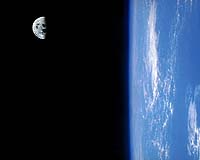
Pasadena CA (SPX) Sep 28, 2005 In recent years, mathematicians have discovered an almost perfect parallel between the motion of spacecraft through the solar system and the motion of atoms in a chemical reaction - a hidden unity that has led to innovative new ways to design space missions. The celestial half of this unity arises from the theory of "dynamical systems," which describes how a group of celestial bodies such as the Sun, the Earth and a spacecraft will move under the influence of their mutual gravity. It turns out that the tangle of gravitational forces creates tubular "highways" in the space between the bodies; if the spacecraft enters one of the highways, it will be whisked along without the need to use much propellant of its own. The atomic half, meanwhile, arises from the theory of "transition states," which describes how atoms are transferred from one molecule to another during the course of a chemical reaction. The unity exists because the same mathematical equations apply in both cases -which means that insights gained from analyzing one class of problems can help analyze the other. Indeed, when NASA was preparing for its recent Genesis mission to sample the solar wind, the agency planned the spacecraft's complex orbit with the help of specialists in atomic physics, such as mathematician Jerrold Marsden of the California Institute of Technology, engineer Shane Ross of the University of Southern California, and physicist Turgay Uzer of the Georgia Institute of Technology. The work of all three scientists, who have received funding to study the field from the National Science Foundation (NSF), is featured in an article that appears in the Oct. 2005 issue of the Notices of the American Mathematical Society. Community Email This Article Comment On This Article Related Links American Mathematical Society SpaceDaily Search SpaceDaily Subscribe To SpaceDaily Express Space Tourism, Space Transport and Space Exploration News
 NASA Refines Design For Crew Exploration Vehicle
 Washington DC (SPX) Jan 12, 2006
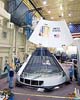
NASA's Constellation Program is making progress toward selecting a prime contractor to design, develop and build the Crew Exploration Vehicle (CEV), America's first new human spacecraft in 30 years. |
|
|

| The content herein, unless otherwise known to be public domain, are Copyright 1995-2006 - SpaceDaily.AFP and UPI Wire Stories are copyright Agence France-Presse and United Press International. ESA PortalReports are copyright European Space Agency. All NASA sourced material is public domain. Additionalcopyrights may apply in whole or part to other bona fide parties. Advertising does not imply endorsement,agreement or approval of any opinions, statements or information provided by SpaceDaily on any Web page published or hosted by SpaceDaily. Privacy Statement |