|
 |
 |
 |
 |
 |
 |
 |
 |

 |
Massive Galaxies Formed Quickly In Early Universe
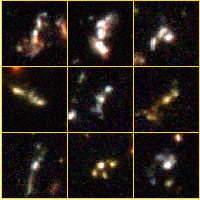
Surrey, UK (SPX) Feb 20, 2006 British researchers said Sunday they have found the first observational evidence of how massive galaxies formed in the universe. The researchers said the results - which could have major implications for many other research areas - already are being used by astronomers to explain seemingly unrelated processes, such as how massive black holes and the universe's stars came to be. The team, led by Christopher J. Conselice of The University of Nottingham, used the deepest images taken by the Hubble Space Telescope to study galaxies when the universe was only about 2-billion years old. They found the majority of the most massive galaxies at that time underwent multiple and spectacular mergers. The mergers led to the creation of new stars from colliding gas clouds, and they likely fed and grew the black holes lurking at the center of all galaxies. They said the work is helping to confirm what scientists have long anticipated: massive galaxies form when smaller galaxies merge together - a previously unconfirmed prediction of the cosmological standard model. "The results show us that the most massive galaxies we see in today's universe, which are passive and old, were once undergoing rapid mergers with each other, which it turns out is how they form," Conselice said. Astronomers have studied distant galaxies using the Hubble and other instruments for more than a decade, but until now it has remained a mystery how they evolved into the galaxies seen today. Young galaxies have relatively low masses, and astronomers long have been puzzled by how these systems turned into massive galaxies in the local universe. Conselice said the results demonstrate that a typical massive galaxy in today's universe has undergone four to five mergers with other galaxies to transform from a young and low-mass system into a giant agglomeration of stars. Such mergers are very rare among more contemporary galaxies, with only about 1 per cent merging. About 10 billion years ago, however, nearly all massive galaxies merged. The researchers used an analysis technique developed by Conselice over a period of more than 10 years on some of the deepest images ever taken of the universe to make these discoveries. The results: Massive galaxies neither formed rapidly, within a few million years after the Big Bang, nor gradually, over an extended period of time. Surprising, but almost all galactic merger activity occurred from the birth of the universe until about 6 billion years ago. "Perhaps the most amazing thing about these results is that massive galaxy formation is largely over when the universe is half its current age," Conselice said. "This means that all this merging activity was somehow curtailed by an unknown process." The research may hold clues about the formation of the Milky Way galaxy. The Milky Way contains spiral arms, which are not thought to form through the merger process, but at the galaxy's center is a spherical system of stars called a bulge - a high-density region featuring many old stars and a massive black hole, which probably formed as a result of these mergers. The research also could help astronomers to see into the Milky Way's future. It is thought that the galaxy is headed for a merger with Andromeda, the nearest neighboring large galaxy, about a billion years from now. This would see the destruction of the spiral disk that surrounds the bulge, and dramatically change the galactic shape - and in the process significantly alter the familiar positions of stars in the night sky. Community Email This Article Comment On This Article Related Links Royal Astronomy Society Hubble Space Telescope Science Institute Stellar Chemistry, The Universe And All Within It
 Gamma Ray Flare From Distant Star Disturbs Daytime Ionosphere
 Stanford CA (SPX) Feb 20, 2006
In late 2004 scientists detected the largest gamma-ray burst ever recorded. It came from a magnetar--a neutron star with an enormous magnetic field--50,000 light years away. Its powerful rays penetrated deep into the ionosphere, the electrically conductive layer encircling Earth. On Feb. 19 in St. Louis at the annual meeting of the American Association for the Advancement of Science (AAAS), Stanford electrical engineering Professor Umran Inan will describe what scientists learned from this rare and dramatic atmospheric disturbance. |
|
|

| The content herein, unless otherwise known to be public domain, are Copyright 1995-2006 - SpaceDaily.AFP and UPI Wire Stories are copyright Agence France-Presse and United Press International. ESA PortalReports are copyright European Space Agency. All NASA sourced material is public domain. Additionalcopyrights may apply in whole or part to other bona fide parties. Advertising does not imply endorsement,agreement or approval of any opinions, statements or information provided by SpaceDaily on any Web page published or hosted by SpaceDaily. Privacy Statement |