|
 |
 |
 |
 |
 |
 |
 |
 |

 |
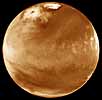
Massive Cyclone Batters Mars
Ithica - May 19, 1999 - Astronomers using NASA's Hubble Space Telescope have spotted an enormous cyclonic storm system raging in the northern polar regions of the planet Mars. Nearly four times the size of the state of Texas, the storm is composed of water-ice clouds like storm systems on Earth, rather than dust typically found in Martian storms. The system is similar to so-called "spiral" storms observed more than 20 years ago by NASA's Viking Orbiter spacecraft, but it is nearly three times as large as the largest previously detected Martian spiral storm system. The storm is nearly 1,100 miles across from east to west and 900 miles from north to south. The eye of the storm is nearly 200 miles in diameter. The system is larger than the planet's residual north polar ice cap, and is comparable in size to similarly shaped terrestrial hurricanes. The storm was detected using the Hubble's Wide Field Planetary Camera-2 by a team of astronomers observing Mars near its closest approach to Earth in nearly eight years. Jim Bell, assistant professor of astronomy at Cornell University, principal investigator on the team of astronomers obtaining and analyzing the Hubble images, says the observations were somewhat serendipitous in that they were made during the same season that the storms were first detected by Viking. "These rapidly growing and decaying systems do appear to be typical of the Martian polar weather at this season, which is mid northern summer," says Bell. "The storm we detected from Hubble appears anomalous because of its size, but I wouldn't be surprised if the Mars Global Surveyor spacecraft sees other storms of this size eventually as well." The storm consists of at least three, and perhaps more, bands of clouds organized into a spiral structure and wrapped counterclockwise around a hollow central core or "eye." The storm appeared in the middle of the Martian northern hemisphere's summer season, after the planet's seasonal carbon dioxide polar cap had completely sublimated away, leaving only the underlying residual water-ice cap. The smaller spiral storms seen previously by Viking were also detected during the northern summer season, and also at high northern latitudes. Apparently, this type of cyclonic circulation, though rare on Mars, must be related to specific climatic conditions unique to the planet's northern polar regions at this season. Similar storms, some comparable in size to the Martian storm, have been seen in Earth's polar regions. On Earth, these polar cyclones appear to be low pressure systems fueled by strong contrasts in oceanic versus atmospheric temperatures. In some cases, winds within Earth's polar cyclones can reach hurricane force. The general appearance of the Martian storm seems consistent with an intense low pressure vortex with rising air causing cloud formation, possibly with a small core that is cloud-free, like the eye of a hurricane. The storm may have been initiated by an unstable frontal system, and then amplified by the strong temperature contrast between the relatively warm high-latitude Martian dark regions and the much colder and stable polar atmosphere. When first imaged by Hubble on April 27, 1999, the storm was located near 65 degrees north latitude and 85 degrees west longitude. When next imaged about six hours later, the storm appeared to have moved only slightly eastward, but seemed to be in the process of dissipating. The storm has not been seen again in subsequent Hubble telescope images, but these have been centered on the opposite side of the planet. The storm might have been a short-lived phenomenon, which would be consistent with the short lifetimes (several days) observed for smaller spiral storms by Viking. "It seems that our knowledge of the high-latitude weather on Mars is limited by the fact that even Viking, from orbit 20 years ago, could not observe the polar regions very frequently," says Cornell's Bell. "So our HST finding, and forthcoming results from the Mars Global Surveyor spacecraft, may simply be revealing all this activity up there because it's the first time we've been able to look in a detailed and dedicated way with high-resolution instruments during this season." The team of astronomers, besides Bell, operator of HST, included Michael Wolff and R. Todd Clancy (Space Telescope Science Institute), Steven Lee (University of Colorado), Philip James (University of Toledo), and Michael Ravine (Malin Space Science Systems, Inc.).
Areography
Email This Article Comment On This Article Related Links Space
 Satellite Launch To Boost DTH In India
 Calcutta, India (SPX) Dec 28, 2005
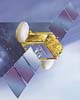
The successful launch Thursday of India's heaviest satellite from spaceport of Kourou in French Guyana may have boosted the country's space research efforts to yet another level, but it has also lifted the spirits of at least three Direct-To-Home televisions broadcasters, one of which has been waiting for years to launch its services in India.
--------------------------------------------------------- It's new. And it's downright terrific! Celestron's CPC Schmidt-Cassegrain telescope is the scope you've been waiting for! It offers new alignment technology, advanced engineering, and bold new design at a new, low price! In fact, Celestron's Professional Computerized (CPC) scope with revolutionary SkyAlign Alignment Technology redefines everything that amateur astronomers are looking for. It offers quick and simple alignment, GPS technology, unsurpassed optical quality, ease of use, advanced ergonomics, enhanced computerization and, most important, affordability. Want to view M-31 tonight? One button takes you there!
Shop for telescopes online at Telescopes.com! today!
|
|
|

|
|
|
|
|
|
|
|
|
|
|
|
| The content herein, unless otherwise known to be public domain, are Copyright 1995-2006 - SpaceDaily.AFP and UPI Wire Stories are copyright Agence France-Presse and United Press International. ESA PortalReports are copyright European Space Agency. All NASA sourced material is public domain. Additionalcopyrights may apply in whole or part to other bona fide parties. Advertising does not imply endorsement,agreement or approval of any opinions, statements or information provided by SpaceDaily on any Web page published or hosted by SpaceDaily. Privacy Statement |