|
 |
 |
 |
 |
 |
 |
 |
 |

 |
Massive CubeSat Launch Fails
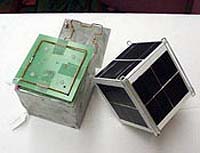
Newington CT (SPX) Jul 28, 2006 A much-heralded attempt to launch 15 CubeSats built by 11 universities and one private company failed this week. Fourteen of the tiny spacecraft carried Amateur Radio transmit-only payloads. All of the satellites appear to have been lost. The Dnepr-1LV rocket lifted off from Russia's Baikonur Cosmodrome in Kazakhstan at 1943 UTC on July 26. Various accounts indicate that the mission went awry less than two minutes after liftoff when the first stage failed to separate on time, causing an emergency shutdown of the rocket's main engine. Reports vary on how far downrange -- and just where -- the vehicle fell. One said the Dnepr dropped to Earth some 15 km from the launch site, while another put the distance at 190 km. A third account said the Dnepr dropped into the Indian Ocean. Originally set for June 28, the launch had been postponed until July 26. The CubeSat project was a collaboration between California Polytechnic State University-San Luis Obispo and Stanford University's Space Systems Development Laboratory. All of the CubeSats were designed and built by students at various universities in the US and elsewhere in the world. The CubeSat roster included AeroCube-1, CP-1, CP-2, ICE Cube-1, ICE Cube-2, ION, HAUSAT-1, KUTESat, MEROPE, nCube-1, RINCON, SACRED, SEEDS, PiCPoT and Voyager. Thirteen of the satellites were to have downlinks in the Amateur Radio satellite allocation between 435 and 438 MHz, and one was to operate on 145.980 MHz. None of the spacecraft carried a transponder. Transmitter power outputs ranged from 10 mW to 2 W. The Dnepr was the second to launch this month from Baikonur's Area 109. Other payloads included BelKA, the first Belarusian satellite, and three other microsatellites. According to Satellite Launch Report, the original Dnepr launcher was replaced by a different one in June after a problem was detected in the original vehicle's digital flight control system. The Dnepr launch failure was said to be the first in seven orbital launch attempts. The Dnepr vehicle is a repurposed SS-18 "Satan" three-stage intercontinental ballistic missile, originally designed in the 1980s to compete with the US Peacekeeper missile. The START 2 treaty allowed up to 150 of the missiles to be converted for use as space launchers. The Russian space agency has convened a special commission to look into the cause of the malfunction. Community Email This Article Comment On This Article Related Links All about the technology of space and more Launch Pad at Space-Travel.com
 INSAT-4C To Be Launched Within A Year
 New Delhi, India (PTI) Jul 28, 2006
After the recent failure of the launch vehicle GSLV-F02 carrying INSAT-4C, Government today informed Lok Sabha that the next launch of the satellite would take place within one year. |
|
|

| The content herein, unless otherwise known to be public domain, are Copyright 1995-2006 - SpaceDaily.AFP and UPI Wire Stories are copyright Agence France-Presse and United Press International. ESA PortalReports are copyright European Space Agency. All NASA sourced material is public domain. Additionalcopyrights may apply in whole or part to other bona fide parties. Advertising does not imply endorsement,agreement or approval of any opinions, statements or information provided by SpaceDaily on any Web page published or hosted by SpaceDaily. Privacy Statement |