|
 |
 |
 |
 |
 |
 |
 |
 |

 |
Massive Antarctic Iceberg Splits: McMurdo Station Further Blocked
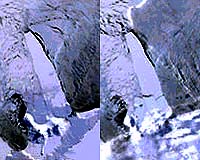
McMurdo Station - Oct 20, 2003 In what could be a boom or a bust for some Antarctic shipping, a massive, 100-mile long iceberg known as B-15A has split in two, satellite photos have confirmed. Monitoring the Antarctic ice using NASA's Terra satellite, scientists at the University of Wisconsin-Madison's Space Science and Engineering Center (SSEC) were among the first to notice the fracture creating two giant icebergs in the Ross Sea, due south of New Zealand. Since B-15A first broke off the Antarctic's Ross Ice Shelf in 2000, the enormous iceberg has been trapping sea ice near Ross Island, home to McMurdo Station, one of the main U.S. scientific outposts in the Antarctic. The trapped ice has made shipping and the delivery of fuel and supplies to McMurdo increasingly difficult. The splitting of B-15A, according to Matthew Lazzara, a meteorologist at SSEC's Antarctic Meteorological Research Center, could help clear the trapped ice near McMurdo, or it could compound the problem, making it even more difficult for ships to traverse the Ross Sea. "It's been kind of stuck in this location for almost two years and the sea ice behind it has been growing thicker instead of dispersing as it usually does," Lazzara says. "It will be interesting to see if it goes away and creates fewer problems or if it makes it even harder to get ships to McMurdo." With support from the National Science Foundation, scientists from UW-Madison and the University of Chicago have together been studying the massive iceberg. Three remotely operated weather stations have been placed on the iceberg by UW-Madison scientists and a Wisconsin team is now in the Antarctic preparing to deploy seismic equipment to the iceberg and perform routine maintenance and repair on the automated weather stations. "The data we're collecting, we hope, will give us some clues about why these things behave as they do," explains Lazzara. "Using the data we collect, and the models developed at the University of Chicago, we hope to get a better understanding of the life cycle of these very large icebergs." The intact B-15A iceberg was an estimated 90 to 100 miles long. The now-split iceberg has divided into two, with one berg about 75 miles long, and the other an estimated 20-25 miles in length. Community Email This Article Comment On This Article Related Links SpaceDaily Search SpaceDaily Subscribe To SpaceDaily Express Dirt, rocks and all the stuff we stand on firmly
 Magnetic Reconnection Region Larger Than 2.5 Million Km Found In The Solar Wind
 Paris (ESA) Jan 12, 2006
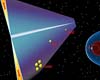
Using the ESA Cluster spacecraft and the NASA Wind and ACE satellites, a team of American and European scientists have discovered the largest jets of particles created between the Earth and the Sun by magnetic reconnection. This result makes the cover of this week's issue of Nature. |
|
|

| The content herein, unless otherwise known to be public domain, are Copyright 1995-2006 - SpaceDaily.AFP and UPI Wire Stories are copyright Agence France-Presse and United Press International. ESA PortalReports are copyright European Space Agency. All NASA sourced material is public domain. Additionalcopyrights may apply in whole or part to other bona fide parties. Advertising does not imply endorsement,agreement or approval of any opinions, statements or information provided by SpaceDaily on any Web page published or hosted by SpaceDaily. Privacy Statement |