|
 |
 |
 |
 |
 |
 |
 |
 |

 |
Martian Science Set To Get Abrasive
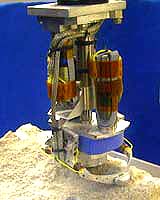
Pasadena - Dec 22, 2003 Facelifts can sag. Botox is temporary. But modern science has a new way to return youth to weathered faces: the rock abrasion tool (RAT). If your dermatologist hasn't heard of it, ask your local Mars scientist. Billions of years of exposure to the sun, atmosphere and extremely fine Martian dust has given Mars rocks a weathered "rind," or exterior layer. The RAT, part of the science-instrument package carried by the two Mars rovers, Spirit and Opportunity, uses a diamond-tipped robotic grinding tool to scrape away this weathered exterior, revealing a fresh surface. "Clearing away the dust and a weathered layer gives the science instruments access to the part of the rock that hasn't changed since it was formed billions of years ago," says Cornell University alumnus Paul Bartlett. An employee of New York engineering firm Honeybee Robotics, Bartlett has been working on the RAT since the first concept drawings from Cornell professor of astronomy Steven Squyres arrived in his fax machine three years ago. Spirit is scheduled to land on Mars on Jan. 3 at 11:35 p.m. EST. Opportunity will touch down on Jan. 25 at 12:05 a.m. EST. The Jet Propulsion Laboratory in Pasadena, a division of the California Institute of Technology, manages the Mars Exploration Rover project for NASA's Office of Space Science, Washington, D.C. Cornell, in Ithaca, N.Y., is managing the science instruments carried by the two rovers, with Squyres as principal investigator. Access to the pristine rock interior is critical to understanding the history of the geology of Mars and to answering what Bartlett describes as the "big questions" to be solved by the rovers: Did water -- or even an environment suitable for life -- once exist on the red planet? These big questions might be answered by a very small machine: The RAT weighs only 1 1/2 pounds and uses less power (30 watts) than most light bulbs. It is about the size of a soda can. The RAT occupies the turret, or "hand," of the rover's robotic arm, along with other rover science instruments for rock analysis, a microscopic imager and Mössbauer and alpha particle X-ray spectrometers. The agile arm, which has shoulder, elbow and wrist joints just like a human arm, presses the RAT up against a rock's surface. In just two hours, the RAT's grinding wheel can shave off a disk about twice the diameter and thickness of a nickel from a hard rock surface. Two brushes sweep the resulting dust away from the hole to provide a clean surface for an up-close view. Once the fresh surface is exposed, the imager and the spectrometers take over, peering through the abraded opening to perform a detailed analysis of the rock's interior. So that scientists can learn about the processes that might have weathered the rock, the rover also records temperature and current readings from the RAT's three motors while they grind away the exterior layer. Bartlett notes that the breadth of his work on the RAT, which spans design, fabrication, assembly, testing and mission operations, "is a rare opportunity in engineering." And working with Mars scientists also has stood out among his other assignments for Honeybee. One was building a robot for an art installation at Manhattan's Whitney Museum of American Art. He discovered, he says, that "planetary scientists and avant-garde architects speak very different languages." This release was prepared by Cornell News Service science-writer intern Kate Becker Community Email This Article Comment On This Article Related Links Honeybee Robotics MER RATs at Cornell Mars at JPL SpaceDaily Search SpaceDaily Subscribe To SpaceDaily Express Mars News and Information at MarsDaily.com Lunar Dreams and more
 Spirit Heading To 'Home Plate'
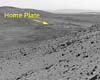 Pasadena CA (JPL) Jan 09, 2006
Last week Spirit completed robotic-arm work on "El Dorado." The rover used all three of its spectrometers plus the microscopic imager for readings over the New Year's weekend. |
|
|

| The content herein, unless otherwise known to be public domain, are Copyright 1995-2006 - SpaceDaily.AFP and UPI Wire Stories are copyright Agence France-Presse and United Press International. ESA PortalReports are copyright European Space Agency. All NASA sourced material is public domain. Additionalcopyrights may apply in whole or part to other bona fide parties. Advertising does not imply endorsement,agreement or approval of any opinions, statements or information provided by SpaceDaily on any Web page published or hosted by SpaceDaily. Privacy Statement |