|
 |
 |
 |
 |
 |
 |
 |
 |

 |
Marshall Space Flight Center Prepares to Implement Space Exploration Missions
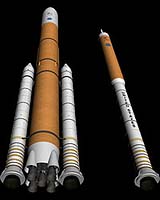
Huntsville AL (SPX) Sep 26, 2005 NASA Marshall Space Flight Center Director David King has announced a realignment of center organizations to conduct new space exploration work, including development of new crew and cargo launch vehicles. "We are enhancing our organization to ensure we successfully accomplish our new missions," said King. This realignment will continue to focus and streamline our customer interfaces and product developments through a flexible, dynamic organization meeting needs throughout the President's Vision for Space Exploration. NASA crew and cargo launch vehicle projects will be managed at Marshall. The crew launch vehicle will be a single four-segment solid propellant rocket booster with a liquid oxygen/liquid hydrogen upper stage powered by one shuttle main engine. Intended to lift crews and cargo into orbit, it will lift 25 metric tons and be 10 times safer than the space shuttle, primarily due to an in-line design and a launch abort system. The heavy-lift launch vehicle will support future lunar exploration missions. It will consist of five shuttle main engines on the core and two five-segment shuttle-derived solid propellant rocket boosters. It will have a lift capability of 106 metric tons to low Earth orbit and 125 metric tons when it incorporates an Earth-departure stage. Although primarily designed to carry cargo, it can be human-rated to carry crew into orbit. Marshall Center will lead the design and development of the new launch systems. These responsibilities include the first stage and upper stage design and engine development, systems engineering and full vehicle stack integration, and safety and mission assurance. The realignment features the creation of two new development offices: the Exploration Launch Office, which will manage the new launch system, and the Science and Mission Systems Office, which will integrate the center's scientific and engineering expertise and more effectively design and develop NASA's science, exploration and space operations mission products, including spacecraft, propulsion elements, robotic systems and research instruments. The Exploration Launch Office will be closely linked to Marshall's Space Shuttle Propulsion office sharing engineering expertise and ultimately a graceful transition from the current shuttle systems to the new launch system. "I believe our ability to integrate our scientific expertise and engineering disciplines will be key to our future success," said King. Systems engineering and integration expertise will be placed in the divisions of the Engineering Directorate to better serve the many programs and projects under way, continuing the broadening and renewal of Marshall's design and development expertise. The center is also creating a program analysis and evaluation function to enhance and integrate center strategic assessments and decisions. "With these changes, we are creating a strong, integrated organization to enable NASA's missions and the exploration vision," King said. Just as in the Apollo era, Marshall Center will play a key role in NASA's achievement of the President's Vision for Space Exploration, which calls for a safe return of the space shuttle to flight, completion of the International Space Station, a return to the moon and exploration of Mars and beyond. This exploration will open opportunities for fundamental science pursuits in astrobiology, lunar geology, exobiology, astronomy and physics. Community Email This Article Comment On This Article Related Links SpaceDaily Search SpaceDaily Subscribe To SpaceDaily Express Space Tourism, Space Transport and Space Exploration News
 Spicing Up Space Meals
 Los Angeles CA (SPX) Jan 04, 2006
Since its launch a year and half ago, Minimus.biz has quickly become the place to go for individual and travel size items. Last week, NASA came to Minimus.biz and purchased several different travel size condiments to send with the astronauts to the International Space Station. |
|
|

| The content herein, unless otherwise known to be public domain, are Copyright 1995-2006 - SpaceDaily.AFP and UPI Wire Stories are copyright Agence France-Presse and United Press International. ESA PortalReports are copyright European Space Agency. All NASA sourced material is public domain. Additionalcopyrights may apply in whole or part to other bona fide parties. Advertising does not imply endorsement,agreement or approval of any opinions, statements or information provided by SpaceDaily on any Web page published or hosted by SpaceDaily. Privacy Statement |