|
 |
 |
 |
 |
 |
 |
 |
 |

 |
Marshall Center Engineers Share Secrets Of Chandra's Darkness-Dodging Orbit
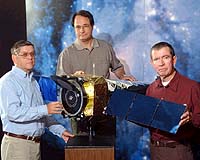
Huntsville - Jun 03, 2002 Every 64 hours, NASA's Chandra X-ray Observatory follows a path that dodges darkness, stretches one-third of the way to the Moon, and has a more elliptical shape than most orbiting satellites. Chandra's unique orbit -- selected by engineers at NASA's Marshall Space Flight Center in Huntsville, Ala. -- is a reflection of the unique requirements to ensure the world's most powerful X-ray telescope could deliver its groundbreaking images to Earth. Chandra began collecting unprecedented images of our universe in August 1999. In just over two years, Chandra has found the most distant X-ray cluster of galaxies, captured the deepest X-ray images ever recorded and discovered a new size of black hole. But before Chandra could achieve those firsts, "deepests" and "farthests," long before the observatory was launched, engineers first had to determine precisely the best path for the observatory to take. "There were several challenges to overcome," said Larry Mullins, the aerospace engineer who led the team to determine Chandra's trajectory -- or flight path. "One challenge was the sheer height of the orbit needed." At its high point, two-hundred-times higher than the Hubble Space Telescope, Chandra's orbit takes it 75,000 miles from Earth, far outside the belts of radiation that surround our planet. This radiation -- while harmless to life on Earth -- can overwhelm an X-ray observatory's sensitive instruments. During each 64-hour orbit, Chandra remains outside the radiation belts long enough to take 55 hours of uninterrupted observations. To achieve this unprecedented altitude for an orbiting satellite, the Marshall engineers crafted an elliptical, or oblong, orbit. "It would have been simpler to create a circular orbit, but at that altitude, it was out of the question," said Mullins, "because at its highest point, Chandra flies about 75,000 miles higher than the Space Shuttle can travel." A Space Shuttle flies as high as 350 miles from Earth. Even at its closest approach to Earth, Chandra's altitude is about 6,000 miles from Earth. Space Shuttle payloads, such as Chandra, destined for altitudes above the Shuttle's range, have rocket motors attached. Fired after the spacecraft is a safe distance from the Shuttle, these rocket motors propel the spacecraft to its final destination. The Chandra X-ray Observatory, with a rocket booster known as the Inertial Upper Stage, and support equipment, was the largest and heaviest payload ever launched by the Space Shuttle. The wide variation between the observatory's highest and lowest point from Earth is the result of the elliptical orbit designed by the Marshall Center trajectory team. To achieve this unusual orbit, rocket boosters propelled the observatory to the required altitude. "In its simplest terms, the concept is similar to a sling-shot," explained Russell Stone, an aerospace engineer in Marshall's Space Transportation Directorate. But the implementation was anything but simple. It took two years just to create the computer software that would enable the team to predict the evolution of Chandra's orbit over its expected 10-year lifetime. Another challenge was ensuring Chandra had nearly uninterrupted access to its power source -- the Sun. Although the observatory has three batteries that store power, the Sun is the sole source of power to those batteries. "The observatory's battery life is two hours," said Stone. "That's how long it can operate on the solar power it's collected, so Chandra can't be in darkness for more than two hours at a time. We had to find a path that minimized its time in Earth's shadow." "We did some parameter studies and found the size and orientation of an orbit that fit all these criteria," said Steve Evans, another member of the Chandra Trajectory team at the Marshall Center. In fact, the engineers don't expect Chandra to go into a shadow for more then two hours at a time for the next 10 years. "Chandra's orbit is so high that it doesn't move into Earth's shadow for every one of its orbits," Evans added. In fact, it is infrequent enough to result in only two eclipse seasons a year, each with about a dozen eclipses. Based on the observatory's outstanding results, in September 2001 managers at NASA Headquarters in Washington, D.C., decided to extend Chandra's mission from its original five-year-mission to a 10-year mission. The extended mission will support five additional years of day-to-day operations such as controlling the spacecraft, observing celestial targets, processing the data, and passing it on to scientists around the globe. It also includes continuing the administration of hundreds of science grants for astronomers to analyze their data and publish their results. What Chandra will discover during its additional five years remains to be seen, but thanks to the efforts of NASA engineers, there's no mystery to the path the observatory will take while delivering its groundbreaking images to stargazers on Earth. Community Email This Article Comment On This Article Related Links Marshall Space Flight Center SpaceDaily Search SpaceDaily Subscribe To SpaceDaily Express Space Tourism, Space Transport and Space Exploration News
 Spicing Up Space Meals
 Los Angeles CA (SPX) Jan 04, 2006
Since its launch a year and half ago, Minimus.biz has quickly become the place to go for individual and travel size items. Last week, NASA came to Minimus.biz and purchased several different travel size condiments to send with the astronauts to the International Space Station. |
|
|

| The content herein, unless otherwise known to be public domain, are Copyright 1995-2006 - SpaceDaily.AFP and UPI Wire Stories are copyright Agence France-Presse and United Press International. ESA PortalReports are copyright European Space Agency. All NASA sourced material is public domain. Additionalcopyrights may apply in whole or part to other bona fide parties. Advertising does not imply endorsement,agreement or approval of any opinions, statements or information provided by SpaceDaily on any Web page published or hosted by SpaceDaily. Privacy Statement |