
 |
 |
 |
 |
 |
 |
 |
 |
 |

 |
Mars lander Phoenix struggles with soil sample
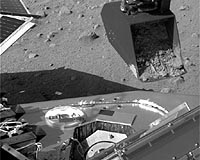
Washington (AFP) June 8, 2008 A soil sample from the Martian arctic dug up by the Phoenix probe appears to be too firmly clumped to deliver any particles into the spacecraft's main test instrument, mission experts said. Apparently no testable bits from the 200 milliliters (12 cubic inches) of Martian permafrost which researchers hope will provide clues to whether the planet was once habitable for microbial life passed through a screen into Phoenix's thermal and evolved gas analyzer (TEGA), Phoenix team experts at the University of Arizona said Saturday. That deduction came after TEGA failed to signal it had received any material from the sample, following its retrieval from the Mars polar surface by Phoenix's articulated robot arm. "I think it's the cloddiness of the soil and not having enough fine granular material," Ray Arvidson, one of the mission's lead scientists, said in a statement. "In the future, we may prepare the soil by pushing down on the surface with the arm before scooping up the material to break it up, then sprinkle a smaller amount over the door," he said. Phoenix relayed images Friday that showed the clump resting on a screen over the TEGA sample port. The screen is designed to allow through it particles measuring one millimeter (0.04 inch) or less. Inside the port there is an infrared beam which is to determine if particles enter the machine. Phoenix, which landed on the stark terrain of Mars' north pole region on May 25, collected the sample on Thursday. The clump of ground was topped by a white crust that set NASA scientists debating whether it is ice or salt deposits from evaporated water. Phoenix mission chief scientist Peter Smith called it a good sample Friday. "This is really an important occasion for us, to be poised to make a measurement for the first time of the polar soil that will tell us how much water is in the soil, and secondly what the minerals are that make up the soil," said Smith. It is the first sample take in the three month project to inspect Mars' soil for the right combination of water in its ice form and minerals that would demonstrate the planet could or can support basic microbial life. Once it gets a sample, the TEGA instrument spends several days analysing its content, first testing for the level of water content, and then heating it gradually to 1,000 degrees Celsius (1,832 Fahrenheit) the better assess the mineral composition. Community Email This Article Comment On This Article Share This Article With Planet Earth
Related Links Mars News and Information at MarsDaily.com Lunar Dreams and more
 Simulations Predicted Mars Lander Would Hit Subsurface
 Ann Arbor MI (SPX) Jun 06, 2008
University of Michigan simulations correctly predicted that the pulsed jets of the Mars Phoenix lander would strip the soil to the subsurface ice or rock as the craft touched down. |
|
|

| The content herein, unless otherwise known to be public domain, are Copyright 1995-2007 - SpaceDaily.AFP and UPI Wire Stories are copyright Agence France-Presse and United Press International. ESA Portal Reports are copyright European Space Agency. All NASA sourced material is public domain. Additional copyrights may apply in whole or part to other bona fide parties. Advertising does not imply endorsement,agreement or approval of any opinions, statements or information provided by SpaceDaily on any Web page published or hosted by SpaceDaily. Privacy Statement |
 del.icio.us
 Digg
Digg Reddit
 YahooMyWeb
 Google
 Facebook