|
 |
 |
 |
 |
 |
 |
 |
 |

 |
Mars Science Community Surprised By Second Rover Proposal
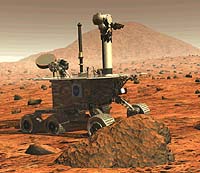
All this makes NASA's sudden turnabout on the Mars rover issue more puzzling. "ScienceNow", the website of the highly respected journal Science -- which first broke the story about a second rover -- reported that the option was considered largely in response to pressure from Mars scientists. But Dr. Squyres contradicts this, telling SpaceDaily that the Athena team itself had absolutely no advance word about the decision and that it "came as a surprise to me and to everybody else on the project". When combined with the fact that the initial press conference at which NASA space science chief Ed Weiler was to announce the selection of the 2003 Mars mission was suddenly cancelled literally at the last minute, this raises another possibility. NASA Administrator Dan Goldin has, in the past, shown a strong tendency to personally intervene in the design of the U.S. Mars program for reasons related entirely to the objective that the mission get good PR, rather than just scientific considerations. In summer 1996, after the revelation of possible ancient microbial fossils in Mars meteorite ALH84001 (an announcement which many scientists feel was itself seriously overhyped by NASA for fundraising purposes), Goldin suddenly ordered a major modification in the design of the Mars program. Previously it had involved a series of low-cost "Mars Surveyor" orbiters and landers designed first to repeat the experiments lost on the Mars Observer, and then to carry out investigations of several different aspects of the planet simultaneously -- not only its potential for holding past or even present microbial life, but also its geology, its climate history, and the extent to which it may hold natural resources useful for later manned expeditions. The difficult and expensive process of actually returning Martian surface samples to Earth for more detailed study -- although obviously important -- was relegated to the longer-term future. After the ALH meteorite press conference Goldin ordered the Mars Surveyor program reoriented to focus centrally on the search for evidence of life. And as part of this, he also ordered a sudden acceleration of the schedule for Mars sample return missions into the near future, with the first sample return mission launched in 2003 -- but without any increase in the program's total funding. The result was that the 1998 Mars missions, strapped for funding, were seriously short changed on preflight testing and inflight analysis, leading to the failure of both. Even without that, Goldin's scheme would have collapsed anyway, for it was already becoming clear that a Mars sample return mission will cost in the neighborhood of $1 billion -- four times what he had hoped. At about the same time, another cool project: namely his proposal that one of the first two tiny "Mars Micromission" spacecraft which the U.S. was planning to launch in 2003 as piggyback payloads on Europe's Ariane 5 rockets should carry a little airplane that would carry out the first powered flight on Mars on Dec. 3, 2003 -- the 100th anniversary of the Wright Brothers' flight. It soon became clear that any airplane tiny enough to fit on a Micromission spacecraft (which weighs less than 400 kg) would have to have both a minimal science payload and a simple rocket engine rather than the propeller drive that had been hoped for -- and that it might very well fail without significant additional research. Consequently that idea also had to be dropped. As such, it's quite likely that the latest sudden modification of the Mars program to include a second 2003 rover was also suggested by Goldin to partly increase the public popularity of Mars exploration. If so -- and if NASA does decide to follow through on it (with a decision due in a couple of weeks) -- one can only hope that its results will be happier, and that the Pluto mission is not scuttled in the process.
Email This Article Comment On This Article Related Links Space
 Satellite Launch To Boost DTH In India
 Calcutta, India (SPX) Dec 28, 2005
The successful launch Thursday of India's heaviest satellite from spaceport of Kourou in French Guyana may have boosted the country's space research efforts to yet another level, but it has also lifted the spirits of at least three Direct-To-Home televisions broadcasters, one of which has been waiting for years to launch its services in India. |
|
|

| The content herein, unless otherwise known to be public domain, are Copyright 1995-2006 - SpaceDaily.AFP and UPI Wire Stories are copyright Agence France-Presse and United Press International. ESA PortalReports are copyright European Space Agency. All NASA sourced material is public domain. Additionalcopyrights may apply in whole or part to other bona fide parties. Advertising does not imply endorsement,agreement or approval of any opinions, statements or information provided by SpaceDaily on any Web page published or hosted by SpaceDaily. Privacy Statement |