|
 |
 |
 |
 |
 |
 |
 |
 |

 |
Mars Rover Inspects Stone Ejected From Crater
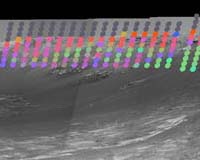
Pasadena (JPL) May 18, 2004 NASA's Mars Exploration Rover Opportunity has begun sampling rocks blasted out from a stadium-sized impact crater the rover is circling, and the very first one may extend our understanding about the region's wet past. Opportunity is spending a few weeks examining the crater, informally named "Endurance," from the rim, providing information NASA will use for a decision about whether to send the rover down inside. That decision will take into account both the scientific allure of rock layers in the crater and the operational safety of the rover. Opportunity has completed observations from the first of three planned viewpoints located about one-third of the way around the rim from each other. Mission controllers at NASA's Jet Propulsion Laboratory, Pasadena, Calif., are sending the rover around the crater's rim counterclockwise. "As we were proceeding from our first viewpoint toward our second viewpoint, we saw a rock that looked like nothing we'd ever seen before," said Dr. Steve Squyres of Cornell University, Ithaca, N.Y., principal investigator for the science instruments on both Mars Exploration Rovers. The rock appears to have come from below the area's current surface level, tossed up by the impact that excavated Endurance Crater. This rock, dubbed "Lion Stone," is about 10 centimeters tall and 30 centimeters long (4 inches by 12 inches). In some ways it resembles rocks that provided evidence of past water at the smaller crater, "Eagle Crater," in which Opportunity landed. Like them, it has a sulfur-rich composition, fine layering and spherical concretions, and likely formed under wet conditions. "However," Squyres said, "it is different in subtle ways from what we saw at Eagle Crater: a little different in mineralogy, a little different in color. It may give us the first hint of what the environment was like before the conditions that produced the Eagle Crater rocks." Inside Endurance Crater are multiple layers of exposed rocks that might provide information about a much longer period of environmental history. From the viewpoints around the rim, Opportunity's miniature thermal emission spectrometer is returning data for mapping the mineral composition of the rocks exposed in the crater's interior. "We see the coarse hematite grains on the upper slopes and basaltic sand at the bottom," said Dr. Phil Christensen of Arizona State University, Tempe, lead scientist for that spectrometer. "Most exciting is the basalt signature in the layered cliffs." Basalt is volcanic in origin, but the thinness of the layers visible in the cliffs suggests they were emplaced some way other than as flows of lava, he said. "Our working hypothesis is that volcanically erupted rock was broken down into particles that were then transported and redeposited by wind or by liquid water," Christensen said. At a press conference today in Montreal, Canada, Christensen and Squyres presented previews of rover-science reports scheduled this week at a joint meeting of the American Geophysical Union and the Canadian Geophysical Union. Although the stack of rock layers at Endurance is more than 10 times thicker than the bedrock exposure at Eagle Crater, it is still only a small fraction of the 200-meter-thick (650- foot-thick) stack seen from orbit at some other locations in Mars' Meridian Planum region. A close-up look at the Endurance Crater rocks could help with interpreting the other exposures seen from orbit. "It's possible that the whole stack was deposited in water -- some particles washed in by flowing water and others chemically precipitated out of the water," Christensen said. "An alternative is that wind blew sand in." Halfway around Mars from Opportunity, Spirit is driving toward highlands informally named "Columbia Hills," where scientists hope to find older rocks than the ones on the plain the rover has been crossing. The rover could reach the edge of the hills by mid-June. "Spirit is making breathtaking progress," Squyres said. "The other day it covered 124 meters [407 feet] in one day. And that's not a parking lot we're crossing. It's hilly, rock-strewn terrain. This kind of pace bodes well for having lots of rover capability left when we get to the hills." Community Email This Article Comment On This Article Related Links Mars Rovers at JPL Mars Rovers at Cornell SpaceDaily Search SpaceDaily Subscribe To SpaceDaily Express Mars News and Information at MarsDaily.com Lunar Dreams and more
 Spirit Heading To 'Home Plate'
 Pasadena CA (JPL) Jan 09, 2006
Last week Spirit completed robotic-arm work on "El Dorado." The rover used all three of its spectrometers plus the microscopic imager for readings over the New Year's weekend. |
|
|

| The content herein, unless otherwise known to be public domain, are Copyright 1995-2006 - SpaceDaily.AFP and UPI Wire Stories are copyright Agence France-Presse and United Press International. ESA PortalReports are copyright European Space Agency. All NASA sourced material is public domain. Additionalcopyrights may apply in whole or part to other bona fide parties. Advertising does not imply endorsement,agreement or approval of any opinions, statements or information provided by SpaceDaily on any Web page published or hosted by SpaceDaily. Privacy Statement |