|
 |
 |
 |
 |
 |
 |
 |
 |

 |
Mars Rover Finds Rock Resembling Meteorites That Fell to Earth
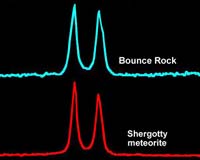
Pasadena CA - Apr 16, 2004 NASA's Opportunity rover has examined an odd volcanic rock on the plains of Mars' Meridiani Planum region with a composition unlike anything seen on Mars before, but scientists have found similarities to meteorites that fell to Earth. "We think we have a rock similar to something found on Earth," said Dr. Benton Clark of Lockheed Martin Space Systems, Denver, science-team member for the Opportunity and Spirit rovers on Mars. The similarity seen in data from Opportunity's alpha particle X-ray spectrometer "gives us a way of understanding 'Bounce Rock' better," he said. Bounce Rock is the name given to the odd, football-sized rock because Opportunity struck it while bouncing to a stop inside protective airbags on landing day. The resemblance helps resolve a paradox about the meteorites, too. Bubbles of gas trapped in them match the recipe of martian atmosphere so closely that scientists have been confident for years that these rocks originated from Mars. But examination of rocks on Mars with orbiters and surface missions had never found anything like them, until now. "There is a striking similarity in spectra," said Christian Schroeder, a rover science-team collaborator from the University of Mainz, Germany, which supplied both Mars rovers' Moessbauer spectrometer instruments for identifying iron-bearing minerals. Mars Exploration Rover scientists described two such meteorites in particular during a Mars Exploration Rover news conference at NASA's Jet Propulsion Laboratory, Pasadena, Calif. One rock, named Shergotty, was found in India in 1865 and it gave its name to a class of meteorites called shergottites. A shergottite named EETA79001 was found in Antarctica in 1979 and has an elemental composition even closer to Bounce Rock's. Those two and about 18 other meteorites found on Earth are believed to have been ejected from Mars by the impacts of large asteroids or comets hitting Mars. Opportunity's miniature thermal emission spectrometer indicates that the main ingredient in Bounce Rock is a volcanic mineral called pyroxene, said science-team collaborator Deanne Rogers of Arizona State University, Tempe. The Moessbauer spectrometer also identified pyroxene in the rock. The high proportion of pyroxene makes it unlike not only any other rock studied by Opportunity or Spirit, but also unlike the volcanic deposits mapped extensively around Mars by a similar spectrometer on NASA's Mars Global Surveyor orbiter, Rogers said. Thermal infrared imaging by another orbiter, Mars Odyssey, suggests a possible origin for Bounce Rock. An impact crater about 25 kilometers wide (16 miles wide) lies about 50 kilometers (31 miles) southwest of Opportunity. The images show that some rocks thrown outward by the impact that formed that crater flew as far as the distance to the rover. "Some of us think Bounce Rock could have been ejected from this crater," Rogers said. Opportunity is driving eastward, toward a crater dubbed "Endurance" that might offer access to thicker exposures of bedrock than the rover has been able to examine so far. With new software to improve mobility performance, the rover may reach Endurance within two weeks, said JPL's Jan Chodas, flight software manager for both Mars Exploration Rovers. Mission controllers at JPL successfully sent new versions of flight software to both rovers. Spirit switched to the new version successfully on Monday, and Opportunity did late Tuesday. A parting look at the small crater in which Opportunity landed is part of a full 360-degree color panorama released at the news conference. The view combines about 600 individual frames from the rover's panoramic camera, said science-team collaborator Jason Soderblom of Cornell University, Ithaca, N.Y. It is called the Lion King panorama because it was taken from a high-ground viewpoint at the edge of the crater, like the high-ground viewpoint used by animal characters in the Lion King story. The panorama gives a good sense of how wind has uncovered the outcrop at the upwind side of the crater and deposited sand in the downwind side of the crater and bright martian dust in the wind shadow of the crater, Soderblom commented. On the wide plain outside the crater lies Bounce Rock. Community Email This Article Comment On This Article Related Links Mars Rovers at JPL Mars Rovers at Cornell SpaceDaily Search SpaceDaily Subscribe To SpaceDaily Express Mars News and Information at MarsDaily.com Lunar Dreams and more
 Spirit Heading To 'Home Plate'
 Pasadena CA (JPL) Jan 09, 2006
Last week Spirit completed robotic-arm work on "El Dorado." The rover used all three of its spectrometers plus the microscopic imager for readings over the New Year's weekend. |
|
|

| The content herein, unless otherwise known to be public domain, are Copyright 1995-2006 - SpaceDaily.AFP and UPI Wire Stories are copyright Agence France-Presse and United Press International. ESA PortalReports are copyright European Space Agency. All NASA sourced material is public domain. Additionalcopyrights may apply in whole or part to other bona fide parties. Advertising does not imply endorsement,agreement or approval of any opinions, statements or information provided by SpaceDaily on any Web page published or hosted by SpaceDaily. Privacy Statement |