
 |
 |
 |
 |
 |
 |
 |
 |
 |

 |
Mars Phoenix lander offers up first secrets
Washington (AFP) June 13, 2008 About three weeks after it landed on Mars, the Phoenix lander has collected particles that offer a snapshot of millions of years of life on the Red Planet, the team behind the probe said Friday. NASA's 420-million-dollar lander has also possibly located ice and is in the process of providing a 360-degree view from its landing site in the Martian polar region, with rocks and hills fading into the dusty distance. "We're getting about twice the data volume we were told to expect," said Peter Smith, Phoenix principal investigator at the University of Arizona. The team is hoping to find evidence of the existence of water and life-supporting organic minerals in the polar region, on the basis that the similar areas on Earth preserve traces of climate change and signs of life. For the past week, Phoenix's robotic arm, which looks like a back-hoe, has been digging into the soil around it and uncovered a bright surface about 2-2.5 inches (5-6 centimeters) below the soil that could be ice. "Not everybody's sure that this is ice. There's been some debate within our team," said Smith. "The debate centers around perhaps there's a salt layer above the ice, which would be very bright and white also." He explained during a televised briefing in Tuscon, Arizona that scraping further into the surface was "really a high priority." Some of the soil collected so far was "very clumpy, its very sticky," Smith said, and initially got stuck on one of Phoenix's oven-like instruments, the Thermal and Evolved-Gas Analyzer (TEGA). Tests are now underway. Other finer particles have been collected in another testing instrument and reveal the history of soil on Mars, ranging from black glassy and potentially volcanic particles to more weathered ones, Phoenix team member Tom Pike said. "What we're looking at here is a potted history of Martian soil," he said. He described "black glassy particles that over millions, even billions of years have been slowly weathering down, becoming iron-enriched which gives the organic material its characteristic (red) color, and we're seeing that process captured on the variety of particles that we're looking at." Pike said that so far, however, "we haven't been able to make a definite confirmation that water has been involved" in this weathering. To provide context to these findings, the lander's stereoscopic imager has provided pictures of the robotic arm collecting samples and its surroundings to show the scientists back on Earth the conditions Phoenix is working in. "We can zoom out to the horizon and see distance features that are observable from orbit, we can see hills fading into the dust in the background, as well as a large number of small rocks," team member Mark Lemmon said. "Ultimately we will get a 360-degree view of our site in full color." The imager can also look into the sky to help Phoenix establish the weather in the polar region along with other meteorological equipment. On Thursday, the temperature on the Mars polar region ranged from minus 30 to minus 85 degrees Celsius (minus 22 to minus 121 degrees Fahrenheit), said Nilton Renno, part of the team responsible for studying Mars' atmosphere. The pressure is "a very small fraction of what we have on Earth" and the wind has been relatively calm, although the level of dust in the atmosphere makes the landing site "like a really polluted place on Earth," he said. "Our results from these analyses are going to be used to inspire future missions that'll come to Mars," Smith said, "and hopefully take over where we leave off because we're bound to raise lots of questions." Community Email This Article Comment On This Article Share This Article With Planet Earth
Related Links Mars News and Information at MarsDaily.com Lunar Dreams and more
 NASA's Phoenix Mars Lander Delivers Soil Sample To Microscope
 Tucson AZ (SPX) Jun 13, 2008
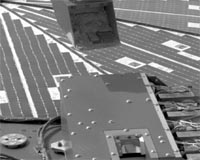
NASA's Phoenix Mars Lander sprinkled a spoonful of Martian soil Wednesday onto the sample wheel of the spacecraft's robotic microscope station, images received early Thursday confirmed. |
|
|

| The content herein, unless otherwise known to be public domain, are Copyright 1995-2007 - SpaceDaily.AFP and UPI Wire Stories are copyright Agence France-Presse and United Press International. ESA Portal Reports are copyright European Space Agency. All NASA sourced material is public domain. Additional copyrights may apply in whole or part to other bona fide parties. Advertising does not imply endorsement,agreement or approval of any opinions, statements or information provided by SpaceDaily on any Web page published or hosted by SpaceDaily. Privacy Statement |
 del.icio.us
 Digg
Digg Reddit
 YahooMyWeb
 Google
 Facebook