|
 |
 |
 |
 |
 |
 |
 |
 |

 |
Mars' Molten Past
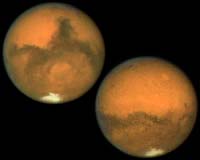
Houston TX (SPX) Nov 22, 2007 Mars was covered in an ocean of molten rock for about 100 million years after the planet formed, researchers from the Lunar and Planetary Institute in Houston, Texas, UC Davis, and NASA's Johnson Space Center have found. The work is published in the journal Nature on Nov. 22. The formation of the solar system can be dated quite accurately to 4,567,000,000 years ago, said Qing-Zhu Yin, assistant professor of geology at UC Davis and an author on the paper. Mars' metallic core formed a few million years after that. Previous estimates for how long the surface remained molten ranged from thousands of years to several hundred million years. The persistence of a magma ocean on Mars for 100 million years is "surprisingly long," Yin said. It implies that at the time, Mars must have had a thick enough atmosphere to insulate the planet and slow down cooling, he said. Vinciane Debraille, a postdoctoral researcher at the Lunar and Planetary Institute, Alan Brandon at the Johnson Space Center, Yin and UC Davis graduate student Benjamin Jacobsen inferred the early history of Mars in the distant past by studying meteorites that fell on Earth. Meteorites called shergottites document volcanic activities in Mars between 470 million and 165 million years ago. These rocks were later thrown out of Mars' gravity field by asteroid impacts and delivered to Earth -- a free "sample return mission" accomplished by nature. By precisely measuring the ratios of different isotopes of neodymium and samarium, the researchers could measure the age of the meteorites, and then use them to work out what the crust of Mars was like billions of years before that. Planets form in three stages, Yin said. First, dust collects into objects tens of miles across. In the second phase, gravity pulls these planetisimals into bigger objects, roughly the size of Mars or the moon. Finally, these small planets collide to form three or four larger terrestrial planets, such as the Earth -- which is about 10 times the mass of Mars. The giant collisions in this final phase would have released huge amounts of energy with nowhere to go except back into the new planet. The rock would have turned to molten magma and heavy metals sank to the core of the planet, releasing additional energy. The molten silicate mantle eventually cooled to form a solid crust on the surface of Mars. Community Email This Article Comment On This Article Related Links UC Davis Mars News and Information at MarsDaily.com Lunar Dreams and more
 Questioning Martian Life
 Paris, France (SPX) Nov 22, 2007
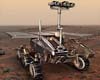
The European Mars Science and Exploration Conference: Mars Express and ExoMars concluded on November 16 at ESA's Technology Centre (ESTEC) in Noordwijk, The Netherlands. The conference covered a range of topics concerning Mars exploration, including results from the Mars Express satellite after almost four years in orbit and preparations for Europe's upcoming ExoMars mission. Here we present interviews with selected experts on some hot topics concerning Mars. |
|
|

| The content herein, unless otherwise known to be public domain, are Copyright 1995-2007 - SpaceDaily.AFP and UPI Wire Stories are copyright Agence France-Presse and United Press International. ESA Portal Reports are copyright European Space Agency. All NASA sourced material is public domain. Additional copyrights may apply in whole or part to other bona fide parties. Advertising does not imply endorsement,agreement or approval of any opinions, statements or information provided by SpaceDaily on any Web page published or hosted by SpaceDaily. Privacy Statement |