|
 |
 |
 |
 |
 |
 |
 |
 |

 |
Mars Missions Have International Flavor
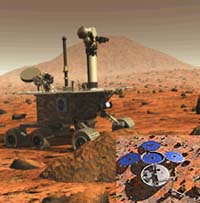
Darmstadt - Dec 04, 2003 A European Space Agency (ESA) mission that will arrive at Mars this month has American participants, and Europeans are team members for two NASA spacecraft that will reach Mars in January. ESA's Mars Express and NASA's twin Mars Exploration Rovers will examine the red planet in quite different and complementary ways. "Together, these missions can provide a range of new information about Mars that neither could provide alone," said Dave Lavery, program executive for the Mars Exploration Rovers and for NASA's participation in Mars Express at NASA Headquarters, Washington. "Historically, there have been only three successful landings on Mars. In the span of only one month, we may double that number, and our knowledge of Mars may increase even more," he said. Mars Express is expected to release part of its payload, the Beagle 2 lander, on Dec. 19. On Christmas Eve (in U.S. time zones), Beagle 2 will parachute to the Martian surface, and Mars Express will enter orbit around the planet. Beagle 2 will use analytical tests and a robotic arm to search for evidence of past or present life at its landing site. The orbiter will use seven instruments to study Mars' atmosphere, structure and geology. The science teams for Beagle 2, and for every instrument on Mars Express, include U.S. researchers. Two instruments on Mars Express have components from U.S. partners in the mission. The Beagle 2 team plans to use NASA's Mars Odyssey orbiter to relay communications to Earth on the lander's arrival day and in subsequent weeks. The U.S. role in Mars Express includes navigational support and software developed from NASA's Jet Propulsion Laboratory (JPL), Pasadena, Calif. And communications support from the JPL-managed Deep Space Network, which operates antenna stations in California, Spain and Australia. One of the Mars Express instruments, with U.S. components, will use radar to seek evidence of underground water, either frozen or liquid. "This will be the first attempt to study layers far below Mars' surface," said JPL's Dr. William Johnson, manager for the instrument, which was built under the leadership of Dr. Giovanni Picardi, University of Rome, La Sapienza. The instrument, the Mars Advanced Radar for Subsurface and Ionosphere Sounding, is designed to discern boundaries between layers as deep as 5 kilometers (3 miles) under the surface. It will also examine the structure and variability of the Martian ionosphere, the top layer of the atmosphere. The University of Iowa, Iowa City, built the transmitter for the radar instrument. JPL built the receiver. Astro Aerospace, Carpinteria, Calif., built the 40-meter (131-foot) antenna. Italy provided the instrument's digital processing system and software and integrated the parts. The other Mars Express instrument with key NASA-funded components is the Analyzer of Space Plasma and Energetic Atoms. It will examine interactions between the Martian atmosphere and the solar wind of charged particles speeding away from the sun. Southwest Research Institute, San Antonio, Texas, built two sensors for it, an electron spectrometer and an ion mass analyzer. Europe provided important tools on NASA's twin Mars Exploration Rovers. The German Space Agency (DLR) and the Max Planck Institute for Chemistry, Mainz, Germany, supplied each rover's alpha particle X-ray spectrometer instrument. DLR and the University of Mainz supplied the Mossbauer spectrometer. The Neils Bohr Institute, Copenhagen, Denmark, supplied the magnet array for observation by rover cameras. Plans call for Mars Express to relay signals from a NASA rover at least once. In addition, Europeans make up about one-sixth of the members of the rovers' science team. The rovers, scheduled to land on Mars on Jan. 3 and on Jan. 25 (Eastern time zone) respectively, will seek evidence about whether the environment in two regions might once have been capable of supporting life. Community Email This Article Comment On This Article Related Links Mars Exploration Rovers at JPL Mars Express Marsis Radar Beagle 2 lander homepage SpaceDaily Search SpaceDaily Subscribe To SpaceDaily Express Mars News and Information at MarsDaily.com Lunar Dreams and more
 Spirit Heading To 'Home Plate'
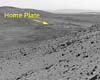 Pasadena CA (JPL) Jan 09, 2006
Last week Spirit completed robotic-arm work on "El Dorado." The rover used all three of its spectrometers plus the microscopic imager for readings over the New Year's weekend. |
|
|

| The content herein, unless otherwise known to be public domain, are Copyright 1995-2006 - SpaceDaily.AFP and UPI Wire Stories are copyright Agence France-Presse and United Press International. ESA PortalReports are copyright European Space Agency. All NASA sourced material is public domain. Additionalcopyrights may apply in whole or part to other bona fide parties. Advertising does not imply endorsement,agreement or approval of any opinions, statements or information provided by SpaceDaily on any Web page published or hosted by SpaceDaily. Privacy Statement |