|
 |
 |
 |
 |
 |
 |
 |
 |

 |
Mars Express - 5000 Orbits And Counting
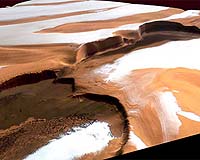
Paris, France (ESA) Nov 26, 2007 On 25 December 2003, Europe's first Mars explorer arrived at the Red Planet. Almost four years later, Mars Express continues to rewrite the text books as its instruments send back a stream of images and other data. Today, the spacecraft reached another milestone in its remarkable career by completing 5000 orbits of Mars. During its mission to investigate martian mysteries, the orbiter has revolutionised our knowledge of Mars, probing every facet of the Red Planet in unprecedented detail. Some of the most visually astonishing results have been returned by the High-Resolution Stereo Camera (HRSC), which has produced breathtaking, 3D colour images of the diverse martian surface - with its giant volcanoes, sinuous valleys and ice-modified craters. While the camera has been imaging the surface in exquisite detail, other instruments have been examining different aspects of the planet's environment. One of the most significant results from the Visible and Infrared Mineralogical Mapping Spectrometer OMEGA has been the discovery of clays, hydrated minerals that formed early in the planet's history, when liquid water was fairly abundant. At the poles, OMEGA has measured the surface composition and produced unprecedented smaps of water ice and carbon dioxide ice. Further insights into the martian poles have come from the Mars Advanced Radar for Subsurface and Ionospheric Sounding, MARSIS, which is revealing, for the first time, the secrets of the planet's subsurface. It has found that the planet's south polar contains enough ice to produce a global ocean 11 m deep. The Planetary Fourier Spectrometer (PFS) has made the most complete map to date of the chemical composition of the martian atmosphere. Meanwhile, the Ultraviolet and Infrared Atmospheric Spectrometer, SPICAM has provided the first complete vertical profile of the atmosphere's carbon dioxide density and temperature. It has revealed a nightglow and aurorae at mid-latitudes, produced the first ozone map and discovered the highest clouds ever observed on Mars. The Energetic Atoms Analyser (ASPERA) has confirmed that solar wind is slowly stripping atoms from the atmosphere down to an altitude of 270 km, although the rate of loss is surprisingly slow. The MaRS radio science experiment has studied surface roughness by pointing the craft's high gain antenna at the planet and recording the echoes. It has also been used to measure small changes in the spacecraft's orbit caused by gravity anomalies. With the mission already extended until at least 2009 and the possibility of further extensions into the next decade, ESA is keen to ensure that Mars Express will continue to provide the best possible scientific return. To meet the needs of the various instruments teams, Mars Express controllers at ESA's Space Operations Centre in Darmstadt, Germany, are currently fine-tuning the spacecraft's orbit. Community Email This Article Comment On This Article Related Links Looking at Mars Mars News and Information at MarsDaily.com Lunar Dreams and more
 Questioning Martian Life
 Paris, France (SPX) Nov 22, 2007
The European Mars Science and Exploration Conference: Mars Express and ExoMars concluded on November 16 at ESA's Technology Centre (ESTEC) in Noordwijk, The Netherlands. The conference covered a range of topics concerning Mars exploration, including results from the Mars Express satellite after almost four years in orbit and preparations for Europe's upcoming ExoMars mission. Here we present interviews with selected experts on some hot topics concerning Mars. |
|
|

| The content herein, unless otherwise known to be public domain, are Copyright 1995-2007 - SpaceDaily.AFP and UPI Wire Stories are copyright Agence France-Presse and United Press International. ESA Portal Reports are copyright European Space Agency. All NASA sourced material is public domain. Additional copyrights may apply in whole or part to other bona fide parties. Advertising does not imply endorsement,agreement or approval of any opinions, statements or information provided by SpaceDaily on any Web page published or hosted by SpaceDaily. Privacy Statement |