Energy News  
Mars Express Uncovering Buried Craters And Underground Ice

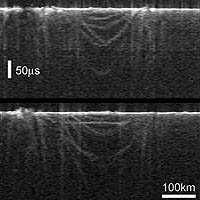
These MARSIS 'radargram' images show echoes obtained from an approximately 250 km diameter circular structure in the subsurface of Mars, interpreted to be a buried impact basin. In both orbits, which are spaced about 50 km apart, MARSIS detected a series of arc-shaped reflectors that have no apparent source in the surface topography or geology.

In the lower image, a linear reflector nearly parallel to the surface is seen embedded in the arcs. This reflection may be coming from the floor of the basin. The time delay to the linear reflector suggests a depth of 1.5-2.5 km. Credits: ASI/NASA/ESA/Univ. of Rome/JPL.


Paris (ESA) Dec 01, 2005
For the first time in the history of planetary exploration, the MARSIS radar on board ESA's Mars Express has provided direct information about the deep subsurface of Mars.

First data include buried impact craters, probing of layered deposits at the north pole and hints of the presence of deep underground water-ice. The subsurface of Mars has been so far unexplored territory. Only glimpses of the Martian depths could be deduced through analysis of impact crater and valley walls, and by drawing cross-sections of the crust deduced from geological mapping of the surface.

With measurements taken only for a few weeks during night-time observations last summer, MARSIS - the Mars Advanced Radar for Subsurface and Ionospheric Sounding - is already changing our perception of the Red Planet, adding to our knowledge the missing 'third' dimension: the Martian interior.

First results reveal an almost circular structure, about 250 km in diameter, shallowly buried under the surface of the northern lowlands of the Chryse Planitia region in the mid-latitudes on Mars. The scientists have interpreted it as a buried basin of impact origin, possibly containing a thick layer of water-ice-rich material.

To draw this first exciting picture of the subsurface, the MARSIS team studied the echoes of the radio waves emitted by the radar, which passed through the surface and then bounced back in the distinctive way that told the 'story' about the layers penetrated.

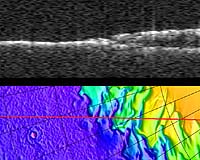
These echo structures form a distinctive collection that include parabolic arcs and an additional planar reflecting feature parallel to the ground, 160 km long. The parabolic arcs correspond to ring structures that could be interpreted as the rims of one or more buried impact basins. Other echoes show what may be rim-wall 'slump blocks' or 'peak-ring' features.


Community
Email This Article
Comment On This Article

Related Links
Mars Express instruments
SpaceDaily
Search SpaceDaily
Subscribe To SpaceDaily Express
Mars News and Information at MarsDaily.com
Lunar Dreams and more


Memory Foam Mattress Review
Newsletters :: SpaceDaily :: SpaceWar :: TerraDaily :: Energy Daily
XML Feeds :: Space News :: Earth News :: War News :: Solar Energy News


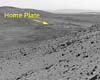
Spirit Heading To 'Home Plate'
Pasadena CA (JPL) Jan 09, 2006
Last week Spirit completed robotic-arm work on "El Dorado." The rover used all three of its spectrometers plus the microscopic imager for readings over the New Year's weekend.


  • Norway And Britain To Cooperate On Underwater CO2 Storage
  • Canadian Technology To Reduce Emissions Around The World
  • Russia Gives Green Light To Siberia-Pacific Pipeline
  • Airline, Auto Sectors Ripe For Carbon Market: IEA

  • Boost To India-US Nuclear Deal
  • British PM Announces Nuclear-Focused Energy Review
  • Ireland Warns Britain Of Opposition To Nuclear Power
  • Blair Pressed Over Nuclear Power Option, Depsite Costs

  • Getting To The TOPP Of Houston's Air Pollution
  • Scientists Seek Sprite Light Source

  • Tree Species Regulate Themselves In Ecological Communities
  • Tropical Dry Forests Receive International Recognition
  • Indonesia's Annual Forest Damage At 2.8 Million Hectares: Minister

  • Fishing Inland Waters Putting Pressure On Fish Stocks
  • Ancient Canals Reveal Underpinnings Of Early Andean Civilization
  • Oil Mist Reduces Airborne Hazards In Concentrated Swine Feeding Operation
  • Swiss Approve Five-Year Ban On GM In Farming

  • GM Hires Russian Nuclear Scientists To Develop New Auto Technology
  • Japan Creates The World's Fastest Electric Sedan
  • Motorists To Pay 'Congestion' Charge Over Broader Swath Of London
  • Solar Cars Driving Towards A Hydrogen Future

  • IAI To Supply Virtual Mission Training System For T6B Aircraft
  • China Negotiating Major Airbus Purchase Source
  • AirAsia To Dramatically Expand On Wings Of New Airbus Planes
  • Geneva Aerospace Extends Its Flight Tech To Raspet's Ultra-Light Glider

  • NASA plans to send new robot to Jupiter
  • Los Alamos Hopes To Lead New Era Of Nuclear Space Tranportion With Jovian Mission
  • Boeing Selects Leader for Nuclear Space Systems Program
  • Boeing-Led Team to Study Nuclear-Powered Space Systems

  • The content herein, unless otherwise known to be public domain, are Copyright 1995-2006 - SpaceDaily.AFP and UPI Wire Stories are copyright Agence France-Presse and United Press International. ESA PortalReports are copyright European Space Agency. All NASA sourced material is public domain. Additionalcopyrights may apply in whole or part to other bona fide parties. Advertising does not imply endorsement,agreement or approval of any opinions, statements or information provided by SpaceDaily on any Web page published or hosted by SpaceDaily. Privacy Statement