
 |
 |
 |
 |
 |
 |
 |
 |
 |

 |
Mars Express To Rendezvous With Martian Moon
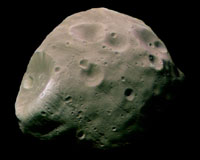
Paris, France (ESA) Jul 17, 2008 Scientists and engineers are preparing ESA's Mars Express for a pair of close fly-bys of the Martian moon Phobos. Passing within 100 km of the surface, Mars Express will conduct some of the most detailed investigations of the moon to date. The series of fly-bys will take place between 12 July and 3 August. During the second encounter, the spacecraft will fly within 273 km of the surface. Six days later, Mars Express will close to within just 97 km. Although the Red Planet itself has been studied in detail, very little is known about the origins of its moons, Phobos and Deimos. It is unclear if the moons are actually asteroids that were captured by Mars's gravity and never left its orbit. Another possibility is that Phobos and Deimos are actually surviving planetesimals, bodies which formed the planets of the Solar System. They may also be remnants of an impact of a large object on Mars. As Mars Express closes-in on Phobos, the data gathered will help scientists answer these questions. Mars Express has flown close to Phobos in the past, but this is the first time that the spacecraft will be less than 100 km from the moon. To achieve this proximity to Phobos, spacecraft operations engineers and scientists have been working together to optimise the trajectory of Mars Express to obtain optimum science results - this is not the case for routine fly-bys. As it flies by at a distance of 97 km, Mars Express will image areas of Phobos that have never been glimpsed before. The High-Resolution Stereo Camera (HRSC) on board the orbiter will take pictures of the moon's surface with the highest resolution possible, in colour, and in 3-D. The data obtained will be added to a digital terrain model (DTM). This DTM will help scientists visualise what it would be like to stand on the moon's surface by calculating its topography, or the elevation of its surface. The camera may also capture an image of the intended landing site for Russia's Phobos-Grunt mission, due for launch in 2009. The manoeuvres required to observe this site are an operational challenge, and the activity involves close cooperation between ESA mission scientists, the flight control team and flight dynamics specialists. The Visible and Infrared Mineralogical Mapping Spectrometer, OMEGA, the Planetary Fourier Spectrometer, PFS, and the Ultraviolet and Infrared Atmospheric Spectrometer, SPICAM, will also gather details on the surface composition, geochemistry and temperature of Phobos. The Mars Advanced Radar for Subsurface and Ionosphere Sounding (MARSIS) will collect information during two flybys (23 and 28 July) on the topography of the moon's surface and on the structure of its interior. The Energetic neutral atoms analyser, ASPERA will study the environment around Phobos, in particular the plasma that surrounds the moon and also the interaction of the moon with the solar wind. During the second fly-by, all efforts will be concentrated on accurately determining the mass of the moon using the Mars Radio Science experiment (MaRS).
The upcoming fly-bys Community Email This Article Comment On This Article Share This Article With Planet Earth
Related Links Mars Express Mars News and Information at MarsDaily.com Lunar Dreams and more
 Five Years Of Mars Express
 Bonn, Germany (SPX) Jun 03, 2008
Now more than ever, Mars is the focus of planetary research. A week after the resoundingly successful landing manoeuvre of NASA's Phoenix probe, scientists and engineers are celebrating the five-year anniversary of the launch of Mars Express, the first ever European planetary mission. |
|
|

| The content herein, unless otherwise known to be public domain, are Copyright 1995-2007 - SpaceDaily.AFP and UPI Wire Stories are copyright Agence France-Presse and United Press International. ESA Portal Reports are copyright European Space Agency. All NASA sourced material is public domain. Additional copyrights may apply in whole or part to other bona fide parties. Advertising does not imply endorsement,agreement or approval of any opinions, statements or information provided by SpaceDaily on any Web page published or hosted by SpaceDaily. Privacy Statement |
 del.icio.us
 Digg
Digg Reddit
 YahooMyWeb
 Google
 Facebook