|
 |
 |
 |
 |
 |
 |
 |
 |

 |
Mars Express Radar Deployment Postponed
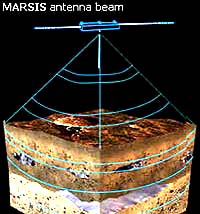
Paris (ESA) Apr 30, 2004 The MARSIS team has advised ESA to delay the deployment of the MARSIS radar instrument on board Mars Express, scheduled for this week. New and improved computer models suggest that, during deployment, the radar booms may swing back and forth with larger amplitudes than previously expected. If this happened, the booms might come too close to delicate components of the spacecraft body. Further simulations and tests are under way to better understand the situation. The two main radar booms are 20-metre long hollow cylinders, of 2.5 centimetres diameter, folded up in a box like a concertina (accordion). When the box is opened, the elastic energy of the compressed glass-fibre booms will let them unfold like a jack-in-the-box. After the booms spring out, they will eventually lock in a straight line, taking up the shape that they had before being folded into the box. The deployment procedure of each boom is expected to last about 10 minutes. Simulations carried out four years ago by the radar boom's manufacturer, Astro Aerospace, California, USA, indicated that the deployment should be smooth, without significantly swinging back and forth. However, the radar team has now advised ESA that a new and refined analysis of the boom dynamics indicates that a sort of "backlash" might take place before the boom locks into its position. Although a successful deployment is not in question, Mars Express mission managers want to make sure that the booms are not subjected to excessive mechanical stress and that they do not interfere with the spacecraft as they deploy. The MARSIS team and their industrial contractors are now performing further tests and simulations to confirm that the deployment will have no impact on the safety of the spacecraft. These simulations will then be reviewed by ESA's experts. Based on the results, expected within a few weeks, ESA will decide when and how to activate MARSIS. MARSIS will study the sub-surface of Mars to a depth of a few kilometres. The instrument's antennas will send radio waves towards the planet and analyse how they are reflected by any surface that they encounter. In this way, MARSIS can investigate the sub-surface mineralogical composition and will reveal the presence of any underground reservoir of water or ice. Community Email This Article Comment On This Article Related Links SpaceDaily Search SpaceDaily Subscribe To SpaceDaily Express Mars News and Information at MarsDaily.com Lunar Dreams and more
 Spirit Heading To 'Home Plate'
 Pasadena CA (JPL) Jan 09, 2006
Last week Spirit completed robotic-arm work on "El Dorado." The rover used all three of its spectrometers plus the microscopic imager for readings over the New Year's weekend. |
|
|

| The content herein, unless otherwise known to be public domain, are Copyright 1995-2006 - SpaceDaily.AFP and UPI Wire Stories are copyright Agence France-Presse and United Press International. ESA PortalReports are copyright European Space Agency. All NASA sourced material is public domain. Additionalcopyrights may apply in whole or part to other bona fide parties. Advertising does not imply endorsement,agreement or approval of any opinions, statements or information provided by SpaceDaily on any Web page published or hosted by SpaceDaily. Privacy Statement |