|
 |
 |
 |
 |
 |
 |
 |
 |

 |
Mars Drill Will Seek Knowledge And Resources
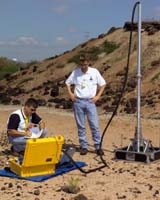
Houston (SPX) Sep 30, 2004 It will be drilling for information first, then for resources, though oil is not likely to be among exploration targets. The futuristic drilling rig, under development at NASA's Johnson Space Center (JSC), Houston, is designed for use on the moon or on Mars. It is currently being tested, in conditions somewhat similar to Mars, until October 3, at the Eureka Weather Station. The station is on Ellesmere Island in Canada's Artic Nunayut province, about 690 miles from the North Pole. Jeffrey A. George is the manager of the Mars Drill Project at JSC. The Canadian tests are being done in cooperation with NASA's Ames Research Center (ARC), Calif., and with faculty members from two Canadian institutions, McGill University in Montreal and the University of Toronto. Baker Hughes of Houston, a company with a rich oil field history, is participating in the project under a Space Act Agreement with NASA. Setup exercises with the drill were held recently at JSC. Because it is designed for use on other planetary bodies, the drill has weight, size and power consumption limits, said project engineer Brian Derkowski. Power consumption is about 100 watts, enough to illuminate a bright household light bulb. Drill components are designed for minimum weight and size. Because of weight and volume constraints, it cannot, like traditional drilling rigs, use drill pipe or drilling mud. The apparatus consists of a power source, a control box and the drill itself. The drill looks like a vertical pipe mounted on a support in the bottom of half a suitcase. A laptop computer is attached to the control box to record data. The base is anchored to the surface and an electrically powered bit rotates beneath it. The pipe-like drill module follows the bit down. The drill is periodically pulled to the surface by its tether to remove the core and cuttings. "This is the second generation of the drill," George said. "Initially the drill will be used to secure core samples for scientific study. Later versions eventually would drill for resources, like, possibly, subsurface water on Mars. We believe the third or fourth generation will be ready for the moon or Mars. "It should ultimately be able to drill to depths of several hundred meters," he said. At Eureka, the drill is being used on sandstone and rock outcrops, and to drill through ice. Canadian geologists will study retrieved core samples to better understand the geology and biology of the high Arctic. The JSC team is relatively small with four members at Eureka. But, George said, it has gotten considerable support from other organizations at JSC, ARC and Baker Hughes. George believes the concept shows considerable promise. "It is a unique technology," he said. Community Email This Article Comment On This Article Related Links Mars Drillers at NASA SpaceDaily Search SpaceDaily Subscribe To SpaceDaily Express Mars News and Information at MarsDaily.com Lunar Dreams and more
 Spirit Heading To 'Home Plate'
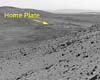 Pasadena CA (JPL) Jan 09, 2006
Last week Spirit completed robotic-arm work on "El Dorado." The rover used all three of its spectrometers plus the microscopic imager for readings over the New Year's weekend. |
|
|

| The content herein, unless otherwise known to be public domain, are Copyright 1995-2006 - SpaceDaily.AFP and UPI Wire Stories are copyright Agence France-Presse and United Press International. ESA PortalReports are copyright European Space Agency. All NASA sourced material is public domain. Additionalcopyrights may apply in whole or part to other bona fide parties. Advertising does not imply endorsement,agreement or approval of any opinions, statements or information provided by SpaceDaily on any Web page published or hosted by SpaceDaily. Privacy Statement |