
 |
 |
 |
 |
 |
 |
 |
 |
 |

 |
Mars Cold Goes Down Deep
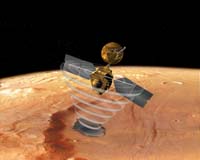
Moffett Field CA (SPX) May 27, 2008 New observations from NASA's Mars Reconnaissance Orbiter indicate that the crust and upper mantle of Mars are stiffer and colder than previously thought. The findings suggest any liquid water that might exist below the planet's surface and any possible organisms living in that water, would be located deeper than scientists had suspected. "We found that the rocky surface of Mars is not bending under the load of the north polar ice cap," said Roger Phillips of the Southwest Research Institute in Boulder, Colo. Phillips is the lead author of a report published in the online version of Science. "This implies that the planet's interior is more rigid, and thus colder, than we thought before." The discovery was made using the Shallow Radar (SHARAD) instrument on the Orbiter, which has provided the most detailed pictures to date of the interior layers of ice, sand and dust that make up the north polar cap on Mars. The radar images reveal long, continuous layers stretching up to 600 miles or about one-fifth the length of the United States. In our first glimpses inside the polar ice using the radar on Mars Reconnaissance Orbiter, we can clearly see stacks of icy material that trace the history of Mars's climate," said Jeffrey Plaut from NASA's Jet Propulsion Laboratory in Pasadena, Calif. Plaut is a science team member and a co-author of the paper. "Radar has opened up a new avenue for studying Mars's past." The radar pictures show a smooth, flat border between the ice cap and the rocky Martian crust. On Earth, the weight of a similar stack of ice would cause the planet's surface to sag. The fact that the martian surface is not bending means that its strong outer shell, or lithosphere, a combination of its crust and upper mantle, must be very thick and cold. "The lithosphere of a planet is the rigid part. On Earth, the lithosphere is the part that breaks during an earthquake," said Suzanne Smrekar, deputy project scientist for Mars Reconnaissance Orbiter at JPL. "The ability of the radar to see through the ice cap and determine that there is no bending of the lithosphere gives us a good idea of present day temperatures inside Mars for the first time." Temperatures in the outer portion of a rocky planet like Mars increase with depth toward the interior. The thicker the lithosphere, the more gradually the temperatures increase. The discovery of a thicker martian lithosphere therefore implies that any liquid water lurking in aquifers below the surface would have to be deeper than previously calculated, where temperatures are warmer. Scientists speculate that any life on Mars associated with deep aquifers also would have to be buried deeper in the interior. The radar pictures also reveal four zones of finely spaced layers of ice and dust separated by thick layers of nearly pure ice. Scientists think this pattern of thick ice-free layers represents cycles of climate change on Mars on a time scale of roughly one million years. Such climate changes are caused by variations in the tilt of the planet's rotational axis and in the eccentricity of its orbit around the sun. The observations support the idea that the north polar ice cap is geologically active and relatively young, at about 4 million years. Community Email This Article Comment On This Article Share This Article With Planet Earth
Related Links Shallow Radar (SHARAD) Website Mars News and Information at MarsDaily.com Lunar Dreams and more
 MDA Solution To Look For Clues Of Water Above And Below The Surface Of Mars
 Richmond, Canada (SPX) May 25, 2008
MacDonald, Dettwiler and Associates reports that its engineers are preparing to support a Space mission which will look for evidence of water on Mars. As NASA's Phoenix spacecraft makes its final approach for a May 25th landing on Mars, engineers from MDA will support critical weather and robotics systems on-board the spacecraft from the mission operations center at the University of Arizona in Tucson. |
|
|

| The content herein, unless otherwise known to be public domain, are Copyright 1995-2007 - SpaceDaily.AFP and UPI Wire Stories are copyright Agence France-Presse and United Press International. ESA Portal Reports are copyright European Space Agency. All NASA sourced material is public domain. Additional copyrights may apply in whole or part to other bona fide parties. Advertising does not imply endorsement,agreement or approval of any opinions, statements or information provided by SpaceDaily on any Web page published or hosted by SpaceDaily. Privacy Statement |
 del.icio.us
 Digg
Digg Reddit
 YahooMyWeb
 Google
 Facebook