|
 |
 |
 |
 |
 |
 |
 |
 |

 |
Mars-500 Experiment Could Be Extended To 700 Days
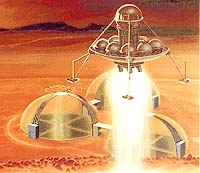
Zhukovsky, Russia (RIA Novosti) Aug 23, 2007 A simulated Mars mission, expected to be launched in Russia later this year, could be extended from 500 to 700 days, the head of the Russian Space Agency said Wednesday. Speaking at the MAKS-2007 air show outside Moscow, Anatoly Perminov said: "There are proposals to extend the Mars-500 experiment at the Russian Institute of Medical and Biological Studies...probably to 700 days." Five volunteers have already been chosen from among 150 applicants, including 16 women, to participate in a simulated space flight whose start has been scheduled for the last quarter of 2007. The six-member crew will spend almost two years inside an experimental research complex comprising five modules set up on the institute's premises to experience the daily routine of professional astronauts, including medicals, workouts and maintenance of station equipment, and will have to cope with simulated emergency situations, arising both from human error and equipment failure. The experiment is divided into three parts - a flight "en route" to Mars, landing and staying on the Red Planet's surface and a journey "back to Earth." The crew is expected to spend the duration of the experiment in an artificial atmosphere, with normal barometric pressure, and to consume food rations similar to those used by astronauts on board the International Space Station. The European Space Agency has expressed an interest in contributing to the project, including research and financial support.
Source: RIA Novosti Community Email This Article Comment On This Article Related Links Mars News and Information at MarsDaily.com Lunar Dreams and more
 Dust From Martian Sky Accumulates On Solar Panels
 Pasadena CA (JPL) Aug 22, 2007
Even though the Martian sky above Gusev Crater continued to clear, solar power levels on NASA's Spirit rover remained fairly constant as dust settling from the atmosphere accumulated on top of the solar panels. Activities remained restricted. Measurements of atmospheric opacity, known as Tau, dropped from 3.6 on Martian day, or sol, 1283 (Aug. 12, 2007) to 3.3 on sol 1286 (Aug. 16, 2007), generating power levels of 301 watt-hours (100 watt-hours is the amount of energy needed to light a 100-watt bulb for one hour). |
|
|

| The content herein, unless otherwise known to be public domain, are Copyright 1995-2007 - SpaceDaily.AFP and UPI Wire Stories are copyright Agence France-Presse and United Press International. ESA Portal Reports are copyright European Space Agency. All NASA sourced material is public domain. Additional copyrights may apply in whole or part to other bona fide parties. Advertising does not imply endorsement,agreement or approval of any opinions, statements or information provided by SpaceDaily on any Web page published or hosted by SpaceDaily. Privacy Statement |