|
 |
 |
 |
 |
 |
 |
 |
 |

 |
Marking Time In Our Journey Into Space
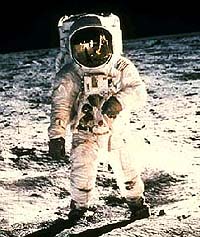
Paris (AFP) July 21, 2000 - Paris (AFP) July 21, 2000 - The heroic age of space exploration is over. Recent years have brought a slow, steady build-up in our understanding of the universe. But as man stares at the stars and wonders about the century ahead, he is faced, not with with fewer questions but more. Forty-three years since a Soviet sputnik became the first man-made object to break free of the earth's gravity, the world has settled into a routine of safe, unspectacular and above all cheaper missions aimed at consolidating the breakthroughs of the past. Over the coming decade the major space powers -- the United States, Russia, Europe and Japan -- have planned around 50 missions. These ventures will come framed in dense technical vocabulary and will attempt to cast light on obscure, invisible or ephemeral aspects of space that are likely to lack the headline appeal of moon landings. The next generation of astronomers will look through extraordinarily sensitive telescopes. Unmanned probes will search for organisms on the moons of Jupiter and Saturn. The sky will be raked for all manner gamma rays, microwaves, gravity fields, dark matter and -- the Holy Grail -- signs of life. "In the next few years we will have physically placed detectors on far-away bodies in the solar system. We will certainly explore comets, asteroids and satellites of other planets," says Jean-Pierre Luminet, research director at the Meudon observatory close to Paris. One reason for the change in tack is money. Though the prospect of self-sufficient communities on the Moon or Mars has its attractions, particularly to pressure groups such as the Alabama-based Artemis Foundation, the reality is that governments are reluctant to plough billions of dollars into high-risk colonisation projects. Estimates for the cost of a manned mission to Mars, for instance, range between 20 and 50 billion dollars. When the Mars Climate Orbiter and Mars Polar Lander ended their flights in abject failure last year, NASA calculated the loss at close to 300 million dollars. But even if the money were present, space itself seems more forbidding than ever. What scientists know of nearby planets show them to be generally gaseous, hostile and toxic, with the prospect of human inhabitation close to nil. As for what lies beyond the tiny corner of the universe known as the solar system, our chances of safe arrival seem minimal. According to Jacques-Emil Blamont of France's national centre for space studies, the most juice that could possibly be got out of modern technology is 200 kilometres (125 miles) a second through airless space. That would get an astronaut to Pluto in about a year and a half; the nearest star, unfortunately, is 10,000 times further away. "If we extrapolate and suppose that we have no new technology beyond super-propulsors, super-rockets and matter/anti-matter, then even if we place all the available energy into the gigantic distance between stars, we will still not leave the solar system," says Luminet. Disappointing as this may be for science-fiction enthusiasts, scientists currently argue that planet Earth and its immediate environs provide mysteries enough for the time being. Modern astronomy in fact seems to have forsaken the glory of expedition for the detail of theory. Astronomy, particle physics and mathematical theory are dovetailing into one massive field of study aimed at finding out the deep truths of the universe. "To truly understand the history of the universe, scientists must discover the profound links between the cosmic realm of the very large and the quantum world of the very small," British astronomer Martin Rees noted recently in the review Scientific American. Sampling and deciphering solar winds, cosmic rays or the universe's background radiation is all part of the process. The European Space Agency's Planck mission, set for launch in 2007, bluntly proclaims its quest to be the origin of everything -- a search for the radiation that originated with the Big Bang and which could lead to enormous leaps in understanding, and thus exploration. "Perhaps by 2050 or 2060, we'll have a theoretical advance, then followed by experimental confirmation, that the structure of space is much more subtle and complicated than we now believe -- and that there are short cuts in space-time," Luminet suggests. One popular theory is that worm-holes with "throats" the size of 1/1,000 million million million million millionth (one over 10 to the power 33) of a centimetre could provide rapid if problematic access to other regions of a hugely diverse universe. However in the short term (the next 100 years, say), and despite current daydreams about space tourism and orbiting hotels, the prospect of manned rocket travel to far-flung galaxies will remain a subject for fiction -- just as the landing on the Moon was until mankind took a certain giant step. Copyright 2000 AFP. All rights reserved. The material on this page is provided by AFP and may not be published, broadcast, rewritten or redistributed.
Email This Article Comment On This Article Related Links Space
 Satellite Launch To Boost DTH In India
 Calcutta, India (SPX) Dec 28, 2005
The successful launch Thursday of India's heaviest satellite from spaceport of Kourou in French Guyana may have boosted the country's space research efforts to yet another level, but it has also lifted the spirits of at least three Direct-To-Home televisions broadcasters, one of which has been waiting for years to launch its services in India. |
|
|

|
|
|
|
|
|
|
|
|
|
|
|
| The content herein, unless otherwise known to be public domain, are Copyright 1995-2006 - SpaceDaily.AFP and UPI Wire Stories are copyright Agence France-Presse and United Press International. ESA PortalReports are copyright European Space Agency. All NASA sourced material is public domain. Additionalcopyrights may apply in whole or part to other bona fide parties. Advertising does not imply endorsement,agreement or approval of any opinions, statements or information provided by SpaceDaily on any Web page published or hosted by SpaceDaily. Privacy Statement |