|
 |
 |
 |
 |
 |
 |
 |
 |

 |
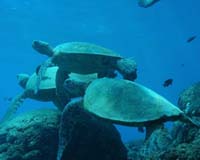
Marine animals 'shop' for food: British researchers
London (AFP) Feb 27, 2008 British researchers believe they have shed new light on how marine animals such as fish, penguins, seals and turtles hunt for food, likening their methods to how humans search for a new restaurant. The team of marine biologists based their conclusions on a study of Antarctic krill, a form of plankton eaten by penguins and seals after finding marked differences in the distribution of the vital food source. Andrew Brierley, from the University of St Andrews' School of Biology Gatty Marine Lab, said hunting strategies closely match the natural distributions of plankton and follow a set pattern of movement. "Predators often hunt by making long initial journeys into a new feeding area -- think of catching a bus in to a new town to look for a restaurant," he said in a statement released by the university Wednesday. "This is followed by a series of smaller jumps to harvest the prey in that region, like walking from the chip shop to the burger van in the same town. "Once all the prey is consumed in the first location, predators then move on in a long jump in search of a new feeding location -- a bit like getting a taxi home to raid the fridge after closing time (at the pub)." The method, without the British-specific cultural analogies, is called "The Levy Walk", which scientists believe could help such animals survive in a harsh environment where the location of food sources is not always predictable. "Predators using Levy search strategies locate food 14 percent more efficiently than random hunters and this might give them the edge in the competitive natural world," Brierley added. The year-long St Andrews research -- details of which will be published in the journal Nature Thursday -- was part of a British Atlantic Survey study into sea-living prey around the remote South Atlantic Ocean island of South Georgia. The Levy method has been a well-established mathematical formula applied to the foraging patterns of a range of birds and land animals. But a Canadian research scientist questioned its accuracy last October, claiming technical mistakes in data collection and methodology that may have tainted results of previous studies. Community Email This Article Comment On This Article Related Links Water News - Science, Technology and Politics
 LSU Researchers Study Coastal Community Bounce Back
 Baton Rouge LA (SPX) Feb 27, 2008
Two LSU researchers are taking what might be the most comprehensive approach ever to determine how some coastal communities bounce back from disaster. The end goal of the project, which is in the early stages of a two-year grant, is to be able to develop and use an index of coastal community resilience to educate and inform decision and policy makers about ways to increase resilience in weaker areas. |
|
|

| The content herein, unless otherwise known to be public domain, are Copyright 1995-2007 - SpaceDaily.AFP and UPI Wire Stories are copyright Agence France-Presse and United Press International. ESA Portal Reports are copyright European Space Agency. All NASA sourced material is public domain. Additional copyrights may apply in whole or part to other bona fide parties. Advertising does not imply endorsement,agreement or approval of any opinions, statements or information provided by SpaceDaily on any Web page published or hosted by SpaceDaily. Privacy Statement |