|
 |
 |
 |
 |
 |
 |
 |
 |

 |
Marine Scientists Monitor Longest Mammal Migration
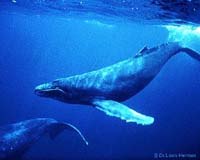
Moss Landing, CA (SPX) Apr 11, 2007 Marine scientists recently published a research paper in the science journal, biology letters, that found humpback whales migrate over 5,100 miles from Central America to their feeding grounds off Antarctica; a record distance undertaken by any mammal. Kristin Rasmussen, a biologist with Cascadia Research Collective, and lead author in the study, finds the record-breaking migration interesting, but is most pleased that the study validates a long held assumption that humpback whales travel to warm water areas during the winter. "It was very exciting because for years everyone said humpback whales could be found in warmer waters during the winter months, but this was the first time we were actually able to quantify this on a global scale, and relate it to these long distance migrations" said Rasmussen. Researchers conducted the survey by identifying individual humpback whales on their wintering area off Central America, and then comparing these with whales identified on their feeding areas off Antarctica. Identification of individual whales is accomplished by comparing a unique set of markings on their fluke, like a "fingerprint," with a catalog of photographs held by the Antarctic Humpback Whale Catalog at the College of the Atlantic in Bar Harbor, Maine. The scientists found some humpbacks traveling from Antarctica across the equator to as far north as Costa Rica to overwinter, a distance of approximately 8,300 kilometers or about 5,157 miles. The authors noticed that the presence of cold water along the equator coincided with the occurrence of this northerly wintering area, not only in the eastern Pacific, where the Central American whales were studied, but also in the eastern Atlantic, where another southern hemisphere humpback whale population can be found north of the equator during winter. Daniel Palacios, an oceanographer working out of NOAA's Southwest Fisheries Science Center laboratory in Pacific Grove, Calif., correlated sea-surface temperature with the whale migration by using data collected from satellites and distributed by the National Oceanographic Data Center. "This study was possible thanks to the availability of reliable, high-resolution sea-surface temperature data collection that cover even the most remote regions of the globe," said Palacios. "Southern Hemisphere humpback whales wintering off Central America: Insights from water temperature into the longest mammalian migration" - PDF Report Community Email This Article Comment On This Article Related Links NOAA NOAA's Southwest Fisheries Science Center NOAA's National Oceanographic Data Center Cascadia Research Collective College of the Atlantic Moss Landing Marine Laboratories Joint Institute for Marine and Atmospheric Research Darwin Today At TerraDaily.com Follow the Whaling Debate Darwin Today At TerraDaily.com
 Trends In Bird Observations Reveal Changing Fortunes For Different Species
 Boston MA (SPX) Apr 09, 2007
Data gathered over decades by the thousands of volunteers who participate in the North American Breeding Bird Survey have yielded a vivid portrait of trends in the abundance of birds in eastern North America. |
|
|

| The content herein, unless otherwise known to be public domain, are Copyright 1995-2006 - SpaceDaily.AFP and UPI Wire Stories are copyright Agence France-Presse and United Press International. ESA PortalReports are copyright European Space Agency. All NASA sourced material is public domain. Additionalcopyrights may apply in whole or part to other bona fide parties. Advertising does not imply endorsement,agreement or approval of any opinions, statements or information provided by SpaceDaily on any Web page published or hosted by SpaceDaily. Privacy Statement |