|
 |
 |
 |
 |
 |
 |
 |
 |

 |
Many Applications Possible For Largest Quantum Infrared Detector
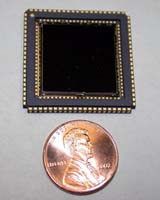
Greenbelt - Mar 3, 2003 The world's first one million-pixel Quantum Well Infrared Photodetector (QWIP) array has been fabricated and tested by a NASA-led team. The new detector promises to be a low-cost alternative to conventional infrared detector technology for a wide range of scientific and commercial applications. "We are excited about the many potential applications for NASA's QWIP technology," said Dr. Murzy Jhabvala, chief engineer of NASA Goddard Space Flight Center's Instrument Technology Center. The development effort was led by the Instrument Systems and Technology Center at NASA Goddard, Greenbelt, Md. The Army Research Laboratory (ARL), Adelphi, Md., was instrumental in the design and fabrication of the QWIP array and the Rockwell Science Center, Camarillo, Calif., provided the silicon readout and hybridization. Engineers at NASA's Jet Propulsion Laboratory (JPL), Pasadena, Calif., also participated in the project. The new array was fabricated in Goddard's Detector Development Laboratory and tested at both Goddard and the ARL. Infrared light is invisible to the human eye, but some types are generated by and perceived as heat. A conventional infrared detector has a number of cells (pixels) that interact with an incoming particle of infrared light (an infrared photon) and convert it to an electric current that can be measured and recorded. They are similar in principle to the detectors that convert visible light in a digital camera. The more pixels that can be placed on a detector of a given size, the greater the resolution, and NASA's latest QWIP array is a significant advance over earlier 300,000-pixel QWIP arrays, previously the largest available. NASA's new QWIP detector is a Gallium Arsenide (GaAs) semiconductor chip with 60 to 100 layers of detector material on top. Each layer is extremely thin, about 500 atoms thick, and the layers are designed to act as quantum wells. Quantum wells employ the bizarre physics of the microscopic world, called quantum mechanics, to trap electrons, the fundamental particles that carry electric current, so that only light with a specific energy can release them. If light with the correct energy hits one of the quantum wells in the array, the freed electron flows through a separate chip above the array, called the silicon readout, where it is recorded. A computer uses this information to create an image of the infrared source. Quantum wells can be designed to detect light with different energy levels by varying the composition and thickness of the detector material layers. Thus, a detector using quantum well technology can be made to sense light (in this case, infrared) with a wide range of energy levels. This is called a broadband detector. "The advantages of GaAs QWIP technology over other infrared detector technologies is the relative ease of fabrication which translates to low production costs and high yield, the ability to spectrally tune the infrared response of the detector over a broad portion of the infrared region (3-18 microns), the very high pixel-to-pixel uniformity and the almost non-existent low frequency (1/f) noise," said Jhabvala. This work was conceived for, and funded by NASA Goddard. The team has recently been selected to develop a broadband (8-14 micrometers) one million-pixel QWIP array-based imaging system as part of the Advanced Component Technology (ACT) development for NASA;s Earth Science Technology Office (ESTO). The initial development of a prototype narrowband one million-pixel QWIP array is a critical first step that significantly contributes to the feasibility of building a broadband far-infrared QWIP camera system under the ESTO program. "The spectral response of the prototype array was between 8.4 and 9.0 micrometers and achieved background limited performance at an operating temperature of 76 Kelvin (minus 197 degrees Celsius or minus 323 degrees Fahrenheit). Numerous imaging experiments (f/2 lens) were performed at the ARL and we are continuing to improve the detector fabrication processes and the detector performance," said Jhabvala.
Community Email This Article Comment On This Article Related Links SpaceDaily Search SpaceDaily Subscribe To SpaceDaily Express Earth Observation News - Suppiliers, Technology and Application
 New Legislation Initiated To Support Commercial Remote Sensing Industry
 New York NY (SPX) Jan 11, 2006
The importance of remotely sensed data and technologies to support natural disasters has prompted attention and action in Washington. New initiatives and legislation authorizing appropriations to the remote sensing industry will be discussed at Strategic Research Institute's U.S. Commercial Remote Sensing Industry conference, scheduled for February 9-10, 2006 in Washington D.C. |
|
|

| The content herein, unless otherwise known to be public domain, are Copyright 1995-2006 - SpaceDaily.AFP and UPI Wire Stories are copyright Agence France-Presse and United Press International. ESA PortalReports are copyright European Space Agency. All NASA sourced material is public domain. Additionalcopyrights may apply in whole or part to other bona fide parties. Advertising does not imply endorsement,agreement or approval of any opinions, statements or information provided by SpaceDaily on any Web page published or hosted by SpaceDaily. Privacy Statement |