|
 |
 |
 |
 |
 |
 |
 |
 |

 |
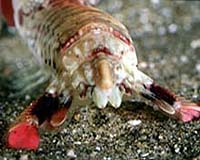
Mantis Shrimp Vision Reveals New Way That Animals Can See
Brisbane, Australia (SPX) Mar 25, 2008 Mantis shrimp can see the world in a way that had never been observed in any animal before, researchers report in the March 20th Current Biology, a Cell Press publication. The discovery-which marks the fourth type of visual system-suggests that the ability to perceive circular polarized light may lend mantis shrimp a secret mode of communication. "Mantis shrimp ventured into a new dimension of vision," said Justin Marshall of the University of Queensland in Australia. Also known as stomatopods, mantis shrimp are large and particularly violent marine crustaceans that aren't actually a kind of shrimp but look something like one. Marshall describes circular polarized light as a spiraling beam that spins either to the left or the right. Scientists had shown before that some animals, such as scarab beetles, reflect that kind of light, but they hadn't shown that any animal could actually see it-until now, that is. "It's complicated physics," Marshall said, "but that makes it all the more amazing that some animals would use it for something." Using it required the stomatopods to evolve a kind of filter in their eyes oriented at a precise 45 degree angle to photoreceptors underneath that pick up on linearly polarized light. The filter turns the circularly polarized light into its linear form. Many animals make use of linearly polarized light, Marshall said. To people, however, it is only glare, hence the need for polarized sun glasses. In the new study, the researchers describe the anatomical basis for stomatopods' remarkable vision in detail and show that these structures are stimulated when circular polarized light shines into them. They also offer behavioral proof of the stomatopods' ability by training them to associate either left-handed or right-handed circular polarized light (L-CPL or R-CPL) with a food reward. During tests, when no food was present, the researchers presented the animals with two feeding tubes, one reflecting L-CPL and the other R-CPL. The stomatopods chose the tube reflecting the CPL handedness to which they had originally been trained at levels significantly above chance, the researchers found. Although it's not yet clear exactly what the mantis shrimps' newfound visual ability is good for in nature, Marshall said it's likely all about sex. Stomatopods are known to use highly specialized color and linear polarization signals for complex social interactions, he noted. And by using circular-polarization imaging, his team has identified three species of stomatopods (within the genus Odontodactus) where CPL is reflected from the cuticles of males but not females. Those sex-specific reflective areas are on parts of the body that stomatopods frequently use for behavioral displays. "The precise role that these signals, visible to a CPL visual system, play in stomatopod sexual signaling is not yet known, but we speculate that these CPL reflections could act as a secret communication channel," the researchers concluded. "Linear polarization signals, used by marine invertebrates, are visible to animals like cephalopods that prey on stomatopods and are therefore open to exploitation. Also, other genera of stomatopods that we have examined have variable CPL sensitivity, and may be unable to view the sexual displays of Odontodactylus species, making this a private channel of communication, unavailable to both predators and potential stomatopod competitors. "Whatever the use of CPL signals and CPL vision to stomatopods, comparing design features of their CPL reflectors and sensors to those of man-made systems will be interesting," they added. "Humans use CPL filters and imaging in everyday photography, medical photography, and object-detection systems in turbid environments. The reefs and waters that many stomatopods inhabit are often turbid, and it is perhaps no surprise that, perhaps as long as 400 million years ago (when stomatopod crustaceans first appeared), nature got there first." Community Email This Article Comment On This Article Related Links Darwin Today At TerraDaily.com
 Stinking seas not to blame for 'mother of all mass extinctions'
 Paris (AFP) March 23, 2008
Scientists on Sunday said they had ruled out a key hypothesis to explain Earth's greatest extinction, when 95 percent of marine species and 70 percent of land species were wiped out. |
|
|

| The content herein, unless otherwise known to be public domain, are Copyright 1995-2007 - SpaceDaily.AFP and UPI Wire Stories are copyright Agence France-Presse and United Press International. ESA Portal Reports are copyright European Space Agency. All NASA sourced material is public domain. Additional copyrights may apply in whole or part to other bona fide parties. Advertising does not imply endorsement,agreement or approval of any opinions, statements or information provided by SpaceDaily on any Web page published or hosted by SpaceDaily. Privacy Statement |