|
 |
 |
 |
 |
 |
 |
 |
 |

 |
Man Of Many Hats Not Ready To Hang Any Up
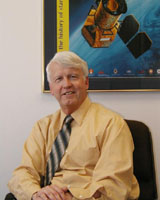
Pasadena CA (SPX) Aug 07, 2006 Imagine walking into the conference room near your office for your weekly staff meeting. Several male co-workers are already seated at the big table, puffing away on cigars. "Things have changed a lot since I first came to JPL in 1969," says Kerry Erickson, mission operations and project manager for the Galaxy Evolution Explorer mission. Galaxy Evolution Explorer, or Galex, is a small, Discovery-class mission. That's why everybody who works on it wears two hats-at least. The spacecraft was launched April 28, 2003, on a mission to do a nearly complete sky survey, peering through 80 percent of the space-time from the here and now back to the Big Bang. Galaxy Evolution Explorer carries a single instrument that has two ultraviolet detectors, one for near-ultraviolet, the longer wavelength part of the ultraviolet range, and the other for far-ultraviolet, the shorter wavelength part of the ultraviolet range. "We have captured a significant portion of the heavens and expect to complete all of our primary surveys by the end of 2007," Erickson maintains. There are no expendables on the spacecraft, so it could potentially last another five to 10 years, gathering further information on star formation. Perhaps that is why Erickson is in no hurry to retire, despite 37 years of service. When he came to JPL, he had been out of school with his bachelor of science degree in electrical engineering from the University of Illinois in Urbana only about three years. He had been recruited from Urbana-Champaign to work for Edgerton, Germeshausen and Grier, Inc., near Las Vegas, on nuclear propulsion and other challenging things. But, after a couple of years, the still-wet ink on new test ban treaties was the writing on the wall that motivated Erickson to apply to JPL. "The same day I got a rejection form letter from JPL, I also got a job offer from the lab's integration and test section," he chuckles. "Thank goodness things have changed a lot in the administrative areas here too." Until then, it hadn't occurred to him that he might have a future in the space program. He had always been interested in communications, tinkering with radios and such since childhood. But he soon learned that those skills and interests go a long way in space. In the 1970s he worked on several missions, including the Mars-bound Mariner 9 and 10 and Viking missions, and Voyager to the outer planets. Erickson also became increasingly involved in mission operations system development. Around 1980 and for the next 20 years, group supervision was added to his duties. Erickson worked on another mission that did not fare as well: Mars Observer, which was lost at orbit insertion in 1994. But even if a spacecraft itself fails to achieve its mission, the advances and lessons learned from its development can greatly benefit missions to follow. Mars Observer marked a time of a great leap forward in mission operations technology and techniques. Erickson explains, "It used to be that project scientists had to come here to JPL to get their data. After Mars Observer, the next series of missions allowed scientists to stay home and get their data right away on their own computers." Married for nearly 40 years, and with two sons and one daughter grown and doing well, Erickson has taken on a new challenge: Attaining a master's in business administration degree. "Even though I've been managing people and projects for a long time, increased globalization makes everything so different now," he says. So why more job-related education at this point, instead of thoughts of retirement? "One day when I'm no longer excited about coming to work, it will be time to hang up my hat. That hasn't happened yet." Community Email This Article Comment On This Article Related Links Galaxy Evolution Explorer Space Tourism, Space Transport and Space Exploration News
 RSC Energia Outlines A Concept Of Russian Manned Space Navigation Development
 Moscow (SPX) Aug 07, 2006
Moscow (SPX) Aug 07, 2006 At OAO Korolev RSC Energia a "Concept of the Manned Space Navigation Development Program in Russia for a period of 2006-2030 years" has been developed and offered for discussion. The concept is interesting not only to specialists, but also to the general public, since a solution of grandiose, qualitatively new tasks is proposed. |
|
|

| The content herein, unless otherwise known to be public domain, are Copyright 1995-2006 - SpaceDaily.AFP and UPI Wire Stories are copyright Agence France-Presse and United Press International. ESA PortalReports are copyright European Space Agency. All NASA sourced material is public domain. Additionalcopyrights may apply in whole or part to other bona fide parties. Advertising does not imply endorsement,agreement or approval of any opinions, statements or information provided by SpaceDaily on any Web page published or hosted by SpaceDaily. Privacy Statement |