|
 |
 |
 |
 |
 |
 |
 |
 |

 |
Malaysian 'Gagarin' hopes to observe Ramadan fast in space
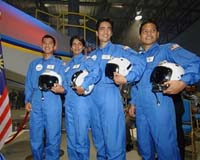
Star City , Russia (AFP) Sept 20, 2007 Malaysia's soon-to-be first astronaut Sheikh Muszaphar Shukor said on Thursday he hoped to fast aboard the International Space Station as he visits there in the holy month of Ramadan. Muszaphar, who is expected to travel to the ISS aboard a Russian Soyuz rocket on October 10, acknowledged that following the normal prayer regime might be difficult, but said that Islam was a "lenient" religion and compatible with space travel. "Of course if we can't do our responsibilities in space we're allowed to do it when we come back. But as a Muslim I do hope to do my responsibilities. I do hope to fast in space," he told journalists at Russia's Star City training centre outside Moscow. "Islam is very lenient. If I can't fast in space I can always come back and do it at a later time, but I will discuss it in detail with my commander," he said. Muszaphar, a 35-year-old doctor and part-time model, has been training at Star City for a year alongside reserve candidate Faiz Khaleed, 27. He will visit the ISS with professional Russian cosmonaut Yury Malenchenko and American Peggy Whitson, spending nine days there before returning to Earth with the current crew. Before the voyage, Malaysia's Department of Islamic Development issued a 20-page book of guidelines on observing Ramadan in space. Otherwise, because the space station circles the Earth 16 times a day, a Muslim would theoretically have to pray 80 times a day. The guidelines stipulate that the astronaut need only pray five times a day, just as on Earth, and that the times should follow the location from which the spacecraft blasted off -- in this case, the Baikonur launch pad. Muszaphar said he had been inspired by the example of the first ever man in space, Russian Yury Gagarin, and hoped to capture the enthusiasm of other Malaysians, helped by a tele-conference and a radio link-up with students. "I'm hoping to become like Yury Gagarin. I remember when I was a child I read a lot about him. He has inspired me so much in my life," he said. "I do hope to become like Yury Gagarin and to spark an interest among the Malaysian people, especially school children." The booklet of Islamic guidelines that has been issued covers among other things washing rituals required before prayer, saying that if water is not available the astronaut can symbolically "sweep holy dust" onto the face and hands "even if there is no dust" in the space station. There are also suggestions on how to pray in a zero-gravity environment. "During the prayer ritual, if you can't stand up straight, you can hunch. If you can't stand, you can sit. If you can't sit, you should lie down," it says. And in the unlikely event of a Muslim astronaut's death, the body should be brought back to Earth for burial, failing which it should be "interred" in Space after a brief ceremony. No details of this are given. The project to send a Malaysian to space was conceived in 2003 when Russia agreed to send a Malaysian to the ISS as part of Malaysia's billion-dollar purchase of 18 Sukhoi 30-MKM fighter jets. Russia has taken a series of "space tourists" to the ISS, mostly businesspeople who have typically paid about 20 million dollars (14 million euros). However Muszaphar said he was planning to help with scientific experiments. Among other things the Soyuz will be taking cancer cells into space to study the effect on them of the weightless environment. Muszaphar added that he would be taking some Malaysian food with him to treat fellow crew members: "We've made sure it's not very spicy so the Russians can eat it very well," he said. Whitson, a biochemist who has previously spent six months on the ISS, said she looked forward to work on expanding the interior of the ISS after recent structural changes. She said she would first be joining October 4 celebrations of the 50th anniversary of the Soviet Union's Sputnik space programme, marking the first time a man-made object orbited the earth. "It's why we're going to space. I really recognise that the 50-year Sputnik anniversary is important to the whole world, not just to Russia," she said. Community Email This Article Comment On This Article Related Links Space Tourism, Space Transport and Space Exploration News
 Global space summit looks to the future, 50 years after Sputnik-1
 Hyderabad, India (AFP) Sept 21, 2007
Fifty years after the launch of the first man-made satellite, the global space industry gathers in India next week to find ways to benefit humanity -- and make money in the process. |
|
|

| The content herein, unless otherwise known to be public domain, are Copyright 1995-2007 - SpaceDaily.AFP and UPI Wire Stories are copyright Agence France-Presse and United Press International. ESA Portal Reports are copyright European Space Agency. All NASA sourced material is public domain. Additional copyrights may apply in whole or part to other bona fide parties. Advertising does not imply endorsement,agreement or approval of any opinions, statements or information provided by SpaceDaily on any Web page published or hosted by SpaceDaily. Privacy Statement |