|
 |
 |
 |
 |
 |
 |
 |
 |

 |
Make Or Break Time For Japan's Rocket Launch Program
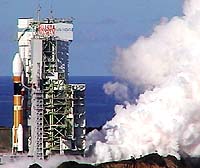
Tokyo (AFP) Aug 28, 2001 Japan's national space agency is set to launch its new H-2A rocket Wednesday and riding on the craft will be the hope of erasing the bitter memory of a string of rocket failures. The launch had been scheduled for Saturday but was postponed at the last minute because of technical hitches. A malfunctioning pressure-control valve, blamed for delaying the weekend takeoff, has been replaced and the rocket is ready for its maiden flight, the National Space Development Agency of Japan (NASDA) said Monday. NASDA hopes the launch will restore confidence in Japan's ability to join the ranks of space-faring superpowers after consecutive failures with the previous rocket, the H-2, in February 1998 and November 1999, when a satellite was lost. Japanese organisations will also be watching closely, in hope that the craft will one day be able to replace their ageing satellites. "Japan's space industry is in a critical position," the NASDA director-general Shuichiro Yamanouchi told AFP when the original launch date was set in May. "If we fail with the next launch, things will become very difficult." Yamanouchi said the agency had done all it could to ensure this launch would be successful, but it could not provide cast-iron guarantees. "As an engineer, it's impossible to say everything's going to be perfect, but we've taken measures one can have confidence in," Yamanouchi was quoted by Jiji Press as saying this month. Yamanouchi, appointed in July last year following the resignation of his predecessor, has made it his priority "to restore confidence" in the Japanese space effort with a successful launch of the H-2A. Weather permitting, the rocket is due to take off at 1:00 pm (0400 GMT) Wednesday from Tanegashima island, about 1,000 kilometres (620 miles) southwest of Tokyo, NASDA said. Potential clients hope the H-2A will enable them to replace their satellites, but the repeated mishaps have made some to look at Europe's commercial launch rival Ariane V as an alternative. "We really need them to launch our satellite," said Japanese Meteorological Agency deputy director for satellite planning, Yasusuke Yoshinaga. The meteorological agency wants to launch the multi-function transport satellite 1-R, which would monitor weather patterns and control aircraft flights, Yoshinaga said. Its current weather satellite, Himawari-5, was launched in March 1995 and was due to be replaced by November 1999. "We are using a weather satellite for longer than it was designed to be used," Yoshinaga said. The replacement satellite had been carried by the H-2A rocket's predecessor, the H-2, which was destroyed minutes after lift off on November 15, 1999 after it experienced engine troubles. The satellite was lost. Yoshinaga said the agency planned to launch a replacement satellite by January or February of 2003. "If H-2A were not ready for use by then, we would use Ariane V. We would launch the satellite regardless of the status of H-2A," he said. Wednesday's scheduled launch will also be watched closely by potential client JSAT, a publicly-traded corporation that manages satellites for broadcast companies such as SkyPerfecTV!. "If it succeeds, that's great. We're not looking forward to it failing. No matter what satellite launcher, we'd like them to succeed," corporate communications manager Shideto Usan said. JSAT operates eight satellites, launched by various craft, including the European Space Agency's Ariane, Titan Corp.'s Titan and Lockheed Martin's Atlas rockets. Usan said his company needed, above all, to trust a launch outfit. "The most important thing is reliability," he said. "We're spending a lot of money on these satellites. If they are launched successfully, that's great. But if it crashes, it's not like we can make another one and put it into space a week later." A European space expert based in Tokyo said NASDA should take heart as failure was part of any space program. "In terms of percentages, Japan has had fewer failures than Ariane at the beginning," said the analyst, who declined to be identified. He conceded though that failure this time would deal the agency hard blow. "It's necessary to regain the confidence of the government and the ministry of finance to secure a budget that allows them to move forward without worries," he said. "That's a strong external pressure on NASDA. If they launch the rocket, it must truly succeed." All rights reserved. � 2000 Agence France-Presse. Sections of the information displayed on this page (dispatches, photographs, logos) are protected by intellectual property rights owned by Agence France-Presse. As a consequence, you may not copy, reproduce, modify, transmit, publish, display or in any way commercially exploit any of the content of this section without the prior written consent of Agence France-Presse. Community Email This Article Comment On This Article Related Links H2A WebCast - Active Aug 25 NASDA SpaceDaily Search SpaceDaily Subscribe To SpaceDaily Express Rocket Science News at Space-Travel.Com
 Successful First Test For Vega's Zefiro 9 Engine
 Paris, France(ESA) Dec 28, 2005
Flames, smoke and a deafening noise accompanied the first firing test of Vega's Zefiro 9 third-stage solid rocket motor. A first examination of the data indicates that everything went well at the test carried out yesterday at Salto de Quirra in southeast Sardinia. |
|
|

|
|
|
|
|
|
|
|
|
|
|
|
| The content herein, unless otherwise known to be public domain, are Copyright 1995-2006 - SpaceDaily.AFP and UPI Wire Stories are copyright Agence France-Presse and United Press International. ESA PortalReports are copyright European Space Agency. All NASA sourced material is public domain. Additionalcopyrights may apply in whole or part to other bona fide parties. Advertising does not imply endorsement,agreement or approval of any opinions, statements or information provided by SpaceDaily on any Web page published or hosted by SpaceDaily. Privacy Statement |