|
 |
 |
 |
 |
 |
 |
 |
 |

 |
Major Physics Breakthrough In Understanding Supersolidity
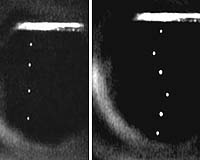
Edmonton, Canada (SPX) Dec 06, 2007 Physicists at the University of Alberta, in Edmonton, Alberta, Canada, have made a major advance in the understanding of what appears to be a new state of matter. Working in the highly specialized field of quantum fluids and solids, Prof. John Beamish, chair of the Department of Physics, and PhD student James Day, report their findings in a paper to be published in the science journal Nature on Wednesday, Dec. 6, 2007. Beamish and Day are the only researchers in Canada conducting experimental research in this area of fundamental physics. At very low temperatures, helium gas turns into a liquid. Put under extreme pressure the liquid turns into a solid. Physicists have been manipulating solid helium so they can study its unusual behaviour. In 2004, a research team at Penn State university in the United States, led by Dr. Moses Chan, electrified the physics world when it announced that it may have discovered an entirely new state of matter - supersolidity. The team made the discovery by cooling solid helium to an extremely low temperature and oscillating the material at different speeds. They found that the particles behaved in a way not seen before, which suggested it might show the "perpetual flow" seen in superfluids like liquid helium. Day and Dr. Beamish have taken this research a different direction. In an experiment not done before, they cooled the solid helium and manipulated the material another way - by shearing it elastically. In doing so, they found that the solid behaved in an entirely new and unexpected way - it became much stiffer at the lowest temperatures. "The experimental results from the University of Alberta are remarkable," Dr. Chan said. "Namely, Professor Beamish and his student James Day found that the shear modulus of solid helium increases by 20% when it is cooled below 0.25K. "Furthermore, the temperature dependence of the shear modulus seems to track the period change seen in torsional oscillator. It seems the two phenomena are related and probably have the same mechanical origin. "This is an important breakthrough since the original discovery," Chan said. Other physicists around the world are also studying the implications. Through this discovery, Beamish and Day have significantly added to the body of knowledge about the fundamental states of matter allowed by nature. Community Email This Article Comment On This Article Related Links University of Alberta Space Technology News - Applications and Research
 Five Years In Orbit For First DMC Satellite AlSAT-1
 London, UK (SPX) Dec 05, 2007
This week, Algeria celebrates the 5th anniversary of its first satellite, AlSAT-1 which marked the beginning of the country's national space programme. Five years on, the African nation not only benefits from improved cartography, pollution monitoring and petrology information, but also makes a significant contribution to international disaster response. |
|
|

| The content herein, unless otherwise known to be public domain, are Copyright 1995-2007 - SpaceDaily.AFP and UPI Wire Stories are copyright Agence France-Presse and United Press International. ESA Portal Reports are copyright European Space Agency. All NASA sourced material is public domain. Additional copyrights may apply in whole or part to other bona fide parties. Advertising does not imply endorsement,agreement or approval of any opinions, statements or information provided by SpaceDaily on any Web page published or hosted by SpaceDaily. Privacy Statement |