|
 |
 |
 |
 |
 |
 |
 |
 |

 |
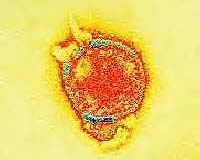
Major Breakthrough In Hendra And Nipah Virus Fight
Bethesda MD (SPX) Jul 07, 2005 An international team, including researchers from CSIRO, have achieved a major breakthrough in the bid to control two killer viruses. The collaborative team, led by Dr Christopher Broder at the Uniformed Services University of the Health Sciences in Bethesda Maryland, have identified a cell receptor for both Hendra virus and Nipah virus. Published in the 05 July issue of the prestigious journal � the Proceedings of the National Academy of Sciences of the United States of America � the research team demonstrated that a cell surface protein ephrin-B2 is a functional receptor for both viruses. CSIRO's Dr Bryan Eaton says that Hendra and Nipah are two newly discovered paramyxoviruses which pose a serious threat to human health. Hendra virus killed two people in Queensland in 1994/95 and re-emerged in the state at the end of 2004. Nipah virus killed more than 100 people in Malaysia in 1999 and re-emerged again in 2001 and 2004 in Bangladesh killing up to 75 per cent of people infected. Dr Eaton says ephrin-B2 is highly conserved in animals, so it is not surprising that the new viruses can infect a wide range of hosts. "As long as a cell receptor is present, both viruses can enter the cells of humans and animals and replicate within, causing disease which is often fatal. "Now that we have identified the cell receptor, we have a target for activity, hopefully blocking the viruses from infecting cells," Dr Eaton says. Dr Chris Broder says the team identified the cell receptor by analysing a human cell line that was resistant to virus infection against two susceptible cell lines. "We identified genes that coded for known and predicted cell surface proteins that were missing from the resistant cell line. The genes were put into cells which were then exposed to live virus at CSIRO Livestock Industries' Australian Animal Health Laboratory (AAHL)," Dr Broder says. The unique biocontainment facilities at AAHL make it one of the few places in the world where testing and research of infectious diseases that affect animals and humans can be safely carried out. Dr Broder says that these experiments showed that the gene for human ephrin-B2 was capable of rendering resistant human cells susceptible to virus infection, indicating that it was the cell receptor. This work is funded by the United States' National Institutes of Health (NIH). Another research team, working independently - led by Dr Benhur Lee from the University of California, Los Angeles � has also identified ephrin-B2 as the cell receptor for Nipah virus. The UCLA research findings were recently published in Nature. Community Email This Article Comment On This Article Related Links Uniformed Services University of the Health Sciences SpaceDaily Search SpaceDaily Subscribe To SpaceDaily Express Dirt, rocks and all the stuff we stand on firmly
 Magnetic Reconnection Region Larger Than 2.5 Million Km Found In The Solar Wind
 Paris (ESA) Jan 12, 2006
Using the ESA Cluster spacecraft and the NASA Wind and ACE satellites, a team of American and European scientists have discovered the largest jets of particles created between the Earth and the Sun by magnetic reconnection. This result makes the cover of this week's issue of Nature. |
|
|

| The content herein, unless otherwise known to be public domain, are Copyright 1995-2006 - SpaceDaily.AFP and UPI Wire Stories are copyright Agence France-Presse and United Press International. ESA PortalReports are copyright European Space Agency. All NASA sourced material is public domain. Additionalcopyrights may apply in whole or part to other bona fide parties. Advertising does not imply endorsement,agreement or approval of any opinions, statements or information provided by SpaceDaily on any Web page published or hosted by SpaceDaily. Privacy Statement |