|
 |
 |
 |
 |
 |
 |
 |
 |

 |
Magnetic Probe For Rocks, Recordings, Nanotechnology
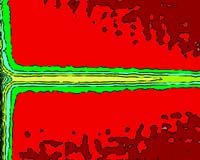
David - May 19, 2003 A technique for studying the magnetic properties of rocks developed by earth scientists at UC Davis is drawing attention from other scientists and the magnetic recording industry. An international group of scientists recently met in Davis to discuss the First Order Reversal Curve (FORC) method and its applications for studying million-year old rocks, thousand-year old lake sediments, modern hard drives and wholly new kinds of materials made in the lab. Magnetic materials are made up of grains that act as tiny magnets. The size and orientation of these grains determines the magnetic properties of the whole material. Magnetic tapes and hard drives use those magnetic grains to store information. The FORC method involves subjecting materials to a series of switching magnetic fields. How they respond gives information about the size, orientation and behavior of magnetic grains in the material. Rocks store magnetic information for millions of years, said UC Davis geophysicist Ken Verosub, who with physicist Christopher Pike and geologist Andrew Roberts (now at the University of Southampton, England) originally developed the method. Grains in rocks are magnetized by the Earth's magnetic field. When the Earth's field changes, some of the grains may change orientation, Verosub said. On a more recent timescale, changes in climate over thousands of years leave magnetic traces in the sediment on the floor of ancient lakes and seas. FORC helps geologists understand how these magnetic signals are recorded in rocks and sediments. It also provides information about magnetic interactions between grains which could be useful for developing better hard drives and magnetic storage devices. Verosub and Pike have joined with physicists Kai Liu, Richard Scalettar and Gergely Zimanyi to explore these new applications of the method. Scalettar, Zimanyi and Pike are using simulations and computer modeling to investigate the underlying physics behind the method. Liu uses FORC to study novel materials, called nanomaterials because they are made up of extremely small layers, dots or other structures, that he makes in the lab. Such materials have novel properties compared to bulk materials because of their extremely small dimensions. Community Email This Article Comment On This Article Related Links FORC method SpaceDaily Search SpaceDaily Subscribe To SpaceDaily Express Nano Technology News From SpaceMart.com Computer Chip Architecture, Technology and Manufacture
 Water, Water Everywhere Nano
 New York (UPI) Mar 18, 2005
One of the single biggest applications of nanotechnology could be solving the global shortage of pure water, experts told UPI's Nano World. |
|
|

| The content herein, unless otherwise known to be public domain, are Copyright 1995-2006 - SpaceDaily.AFP and UPI Wire Stories are copyright Agence France-Presse and United Press International. ESA PortalReports are copyright European Space Agency. All NASA sourced material is public domain. Additionalcopyrights may apply in whole or part to other bona fide parties. Advertising does not imply endorsement,agreement or approval of any opinions, statements or information provided by SpaceDaily on any Web page published or hosted by SpaceDaily. Privacy Statement |