|
 |
 |
 |
 |
 |
 |
 |
 |

 |
Magnetic Field Computers 500 Times Faster
Bath, England (UPI) Jun 22, 2006 Researchers at Britain's University of Bath will lead a $1 million, three-year international project to develop magnetic fields for use in computers. The project could produce a way of carrying electrical signals without the need for wiring. Although WiFi Internet systems and mobile phones already use wireless technology, the electronics that create the wireless signals are too large to be used within individual microchips. The researchers, including scientists in Belgium and France, will look at ways of producing microwave energy by firing electrons into magnetic fields produced in semi-conductors that are only a few atoms wide and layered with magnets. The process -- called inverse electron spin resonance -- uses the magnetic field to deflect electrons and to modify their magnetic direction. That, say scientists, creates oscillations of the electrons that makes them produce microwave energy. That energy then can be used to broadcast electric signals in free space, without the weakening caused by wires. The research, if successful, would allow computers to become up to 500 times faster, yet remain the same size as they are today.
Source: United Press International Community Email This Article Comment On This Article Related Links the missing link Computer Chip Architecture, Technology and Manufacture Nano Technology News From SpaceMart.com
 A Better Wetware Interface
 Martinsried, Germany (SPX) Jun 06, 2006
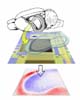
For the first time, scientists at the Max-Planck Institute for Biochemistry in Martinsried near Munich coupled living brain tissue to a chip equivalent to the chips that run computers. The researchers under Peter Fromherz have reported this news in the online edition of the Journal of Neurophysiology (May 10, 2006). |
|
|

| The content herein, unless otherwise known to be public domain, are Copyright 1995-2006 - SpaceDaily.AFP and UPI Wire Stories are copyright Agence France-Presse and United Press International. ESA PortalReports are copyright European Space Agency. All NASA sourced material is public domain. Additionalcopyrights may apply in whole or part to other bona fide parties. Advertising does not imply endorsement,agreement or approval of any opinions, statements or information provided by SpaceDaily on any Web page published or hosted by SpaceDaily. Privacy Statement |