|
 |
 |
 |
 |
 |
 |
 |
 |

 |
Magnetic Bubbles In Space: A New Propulsion Concept?
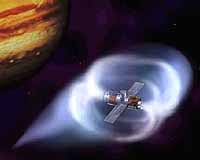
Huntsville - Jan 06, 2004 Exploration of deep space requires new propulsion technologies that not only reduce travel time, but are cost effective and safe as well. One such proposed technology being developed at The University of Alabama in Huntsville is based on the concept of a sail pushed along by space plasma. The basic ingredients of a plasma sail are a magnetic solenoid and a plasma machine aboard a spacecraft. The plasma machine must be capable of releasing a dense and warm plasma cloud. As the cloud expands, the magnetic field lines generated by the solenoid stretch out because of the diamagnetic nature of the plasma. This stretching creates a magnetic bubble, or balloon. Research reveals that available plasma technologies can stretch the "balloon" to distances of several tens of kilometers, according to UAH Professor Dr. Nagendra Singh. "When this bubble intercepts the solar wind, which is a fast stream of plasma coming from the Sun and permeates all over deep space, a propulsive force acts on the spacecraft in a manner similar to the common sail," he said. Singh is a professor of electrical and computer engineering at The University of Alabama in Huntsville. This concept of a plasma sail is still in the initial stages of development, according to Singh. UAH researchers are developing a computer model to study the basic physics of blowing the magnetic bubble as well as how the force acting on the spacecraft to the interaction of the solar wind with the blown magnetic bubble. "Our modeling efforts include state-of-the-art, fully three-dimensional plasma codes and electromagnetic codes to calculate the force," said Dr. Reza Adhami, chairman of UAH's Electrical and Computer Engineering Department. Singh said the blowing magnetic bubbles might have other applications in space exploration. "Such bubbles can be used as protective shields for astronauts against energetically charged particles commonly found in space," he said. Community Email This Article Comment On This Article Related Links University of Alabama in Huntsville SpaceDaily Search SpaceDaily Subscribe To SpaceDaily Express Rocket Science News at Space-Travel.Com
 Successful First Test For Vega's Zefiro 9 Engine
 Paris, France(ESA) Dec 28, 2005
Flames, smoke and a deafening noise accompanied the first firing test of Vega's Zefiro 9 third-stage solid rocket motor. A first examination of the data indicates that everything went well at the test carried out yesterday at Salto de Quirra in southeast Sardinia. |
|
|

| The content herein, unless otherwise known to be public domain, are Copyright 1995-2006 - SpaceDaily.AFP and UPI Wire Stories are copyright Agence France-Presse and United Press International. ESA PortalReports are copyright European Space Agency. All NASA sourced material is public domain. Additionalcopyrights may apply in whole or part to other bona fide parties. Advertising does not imply endorsement,agreement or approval of any opinions, statements or information provided by SpaceDaily on any Web page published or hosted by SpaceDaily. Privacy Statement |