|
 |
 |
 |
 |
 |
 |
 |
 |

 |
Magnesium Diboride: A New High-temp Superconducting Metal
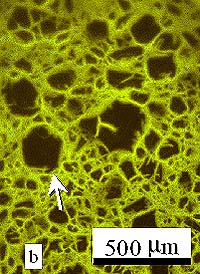
Madison - March 7, 2001 The jolt of excitement from the January discovery of a new high-temperature superconducting metal, magnesium diboride, may get another voltage boost this week with evidence that the material can carry electrical currents at high density. A team of scientists from the university's Applied Superconductivity Center discovered that the material carries large currents without the common barriers seen in the ceramic superconductors in development for real-world electric power applications. Results of the study, done in collaboration with chemist Robert Cava's research group at the Princeton University Materials Institute, are detailed in the Thursday, March 8, issue of the journal Nature. Achieving a high critical current density has been the Achille's heel of ceramic high-temperature superconducting materials, first discovered about 15 years ago. High current densities are vital for enabling superconductivity to enter the mainstream electric utility industry, breaking out from existing medical and scientific uses. The research team found that MgB2 is indeed capable of transporting high electrical currents, because, unlike the ceramic superconductors, the grain boundaries between crystals do not obstruct current flow. "Our evaluation shows that this material is not just interesting scientifically, but practically as well," says David Larbalestier, principal author and ASC director. "MgB2 appears to be a good conductor with a very simple structure with only two atoms to be concerned about." The discovery by Japanese scientists that MgB2 superconducts up to 39 degrees Kelvin (-390 degrees Fahrenheit), almost twice the temperature of any other metallic superconductor, could be a major step toward moving superconductivity from limited application to everyday use. Superconducting materials have the ability to conduct electricity with almost no loss of energy, and are currently being tested in large demonstration motors and power cables to bring high efficiency to energy transmission. But the essential challenge for applications of superconductivity is not just to work at higher temperatures, but to fabricate wires that carry high densities of electric current, Larbalestier says. Current has to weave and meander through billions of obstructive grain boundaries in the ceramic superconductors. Grain boundaries are interfaces a few atoms wide that separate the individual crystals of virtually all solid materials. Because of the obstructive effects of such crystal boundaries, today's ceramic superconductors are reaching only about one-fourth to one-tenth of their potential to carry electricity across distances, Larbalestier says. What the research team found with MgB2 was that crystal boundaries did not obstruct current, allowing high current densities to flow unimpeded. And this compound is unlikely to be the only simple metal boride that superconducts. "Sister compounds that work to higher temperatures than MgB2 probably exist and are under intense study," he adds. The Applied Superconductivity Center is in a unique position to study superconducting materials because it has a broad multi-disciplinary capability for doing both basic and applied studies of superconducting materials. One crucial capability is that of magneto-optical imaging, a technique brought from Russia by ASC scientist Anatoly Polyanskii, which allows the precise flow of electricity through the material to be visualized in fine detail. News of the Japanese discovery spread like wildfire in late January through e-mail between center staff and alumni well before results were public. In late January, Larbalestier and UW-Madison materials science professor Eric Hellstrom decided to make the new material. The very next day, Cava's Princeton research team called to say they had samples of MgB2. "He sent us the sample and the students, staff and postdocs just went at it night and day," Larbalestier says. A flurry of work is rapidly defining the applied potential of this very surprising discovery, not yet two months old. Teams led by Hellstrom and materials science Professor Chang-Beom Eom already have created wires and thin films from the material. UW-Madison physics Professor Mark Rzchowski's group is studying the basic physics of the superconducting mechanism, while materials science Professor Susan Babcock's team is studying its atomic structure using transmission electron microscopy. These studies will be part of a special session of the American Physical Society meeting has been set for Monday, March 12, in Seattle, which will include about 60 presentations worldwide. ASC projects are supported by the Air Force Office of Scientific Research, the Department of Energy and the National Science Foundation, through its Materials Research Science and Engineering Center. Community Email This Article Comment On This Article Related Links Applied Superconductivity Center University of Wisconsin-Madison SpaceDaily Search SpaceDaily Subscribe To SpaceDaily Express Space
 Satellite Launch To Boost DTH In India
 Calcutta, India (SPX) Dec 28, 2005
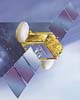
The successful launch Thursday of India's heaviest satellite from spaceport of Kourou in French Guyana may have boosted the country's space research efforts to yet another level, but it has also lifted the spirits of at least three Direct-To-Home televisions broadcasters, one of which has been waiting for years to launch its services in India. |
|
|

|
|
|
|
|
|
|
|
|
|
|
|
| The content herein, unless otherwise known to be public domain, are Copyright 1995-2006 - SpaceDaily.AFP and UPI Wire Stories are copyright Agence France-Presse and United Press International. ESA PortalReports are copyright European Space Agency. All NASA sourced material is public domain. Additionalcopyrights may apply in whole or part to other bona fide parties. Advertising does not imply endorsement,agreement or approval of any opinions, statements or information provided by SpaceDaily on any Web page published or hosted by SpaceDaily. Privacy Statement |