|
 |
 |
 |
 |
 |
 |
 |
 |

 |
Magellanic Clouds And Dark Matter Warping The Milky Way
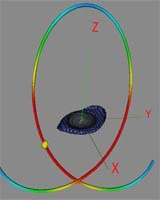
Washington DC (SPX) Jan 10, 2006 After nearly 50 years, astronomers have figured out what causes the mysterious and periodic warping of the structure of the Milky Way galaxy: The Large and Small Magellanic Clouds are interacting with the galaxy's dark matter halo to magnify their gravitational influence, creating the warps as they orbit their parent in a cycle that takes about 1.5 billion years. Using advanced computer models to infer the effects of stellar orbital velocities, astronomers at the University of California , Berkeley, and the University of Massachusetts, Amherst, have determined that the flattened disk of atomic hydrogen that permeates the entire galaxy is vibrating like a drum. Furthermore, this drum produces three distinct "notes" that would register some 64 octaves below middle C on the musical scale. Though the galactic warp was discovered in 1957, its cause has remained unknown until now. "What is new is that this warp can be simply described," said UCB team leader Leo Blitz. Dark matter is the key, Blitz explained to reporters at the American Astronomical Society's annual meeting. Scientists had long dismissed the clouds as potential causes of the warping, because their combined mass amounts to less than 2 percent of the Milky Way's. The new computer model includes the perturbations of the galaxy's massive dark matter halo caused by the motion of the Magellanic Clouds, which creates a wake that enhances their gravitational influence. Though dark matter remains undiscovered via conventional observation, its effect on the gravitational dynamics of galaxies now is widely accepted. The Milky Way's dark matter halo, for example, is at least 20 times more massive than all of its visible, directly detectable matter. It remains the only explanation why the stars in the Milky Way's outer reaches orbit the galactic center far faster than they could if held in their orbits by the gravity of visible matter alone. Blitz added that many other galaxies also seem to exhibit the same type of warping as the Milky Way. "It's very, very common," he said. Community Email This Article Comment On This Article Related Links University of California , Berkeley SpaceDaily Search SpaceDaily Subscribe To SpaceDaily Express Stellar Chemistry, The Universe And All Within It
 Sloan Survey Identifies New Dwarf Galaxy Inside Milky Way
 Washington DC (SPX) Jan 10, 2006
Astronomers using the Sloan Digital Sky Survey have discovered a previously unknown cluster of stars within the Milky Way that appears to be a separate dwarf galaxy being consumed by its much larger neighbor. |
|
|

| The content herein, unless otherwise known to be public domain, are Copyright 1995-2006 - SpaceDaily.AFP and UPI Wire Stories are copyright Agence France-Presse and United Press International. ESA PortalReports are copyright European Space Agency. All NASA sourced material is public domain. Additionalcopyrights may apply in whole or part to other bona fide parties. Advertising does not imply endorsement,agreement or approval of any opinions, statements or information provided by SpaceDaily on any Web page published or hosted by SpaceDaily. Privacy Statement |