|
 |
 |
 |
 |
 |
 |
 |
 |

 |
MTI Micro Delivers On Energy Density Milestone
Albany NY (SPX) Jun 28, 2006 MTI MicroFuel Cells, the developer of the award-winning Mobion micro fuel cell technology and a subsidiary of Mechanical Technology, has announced today that it has achieved an energy density of over 1.3Wh per cc of fuel on a 30 Watt Mobion laboratory test unit. This significant achievement represents more than a 30% increase in fuel efficiency and is an important technical milestone as MTI Micro moves forward in developing Mobion products for a range of applications targeted for the military market. "Achieving both fuel efficiency and power together in the same lab unit is key to making lighter and smaller products with longer run-times than batteries," said Russel Marvin, Chief Operating Officer of MTI Micro. "This is an important step in our DMFC development efforts." For the military markets, MTI Micro is focusing its proprietary Mobion technology along two separate platforms -- a 30 Watt high power platform, and a 1 Watt low power platform -- both targeting key portable applications used in day-to-day military operations. "We recognize what our military customers need -- a rugged, light, compact, power-pack that can work in most operational environments, and run longer than batteries," said Juan Becerra, Vice President of Market and Business Development for MTI Micro. "We are focused on developing products that can meet those requirements and improve the mobility, and effectiveness of our soldiers." For high power applications, MTI Micro's unique direct methanol fuel cell (DMFC) system, Mobion-30, is being designed to produce up to 30 Watts of continuous power in a portable, light-weight, energy-rich, power-pack allowing deployed soldiers to continue the use of multiple portable electronic devices such as communication radios, satellite equipment, laptops, and GPS devices for much longer periods of time. The Mobion-30 system is expected to eliminate the need to carry multiple battery types and the constant swapping of batteries during the course of a mission. In addition, the Mobion-30 may help reduce military operational and logistics costs of tracking, shipping and disposing of millions of batteries. "The latest accomplishments in fuel cell efficiency by MTI Micro are very exciting to AFRL. In particular, these results bode well for the man-pack communications satellite equipment that is being developed by AFRL at this time," said William Cook, Senior Engineer at the Air Force Research Laboratory Information Directorate. "The recent MTI Micro accomplishments will allow for great reductions in the weight of the power system needed to operate the satellite equipment. This is critical for the dismounted soldier. AFRL is anxious to incorporate the MTI fuel cell technology and is looking forward to working with MTI Micro in this area." When compared to batteries required for a 72 hour mission, the Mobion- 30 and two of its easy-to-swap, 100% methanol cartridges are expected to weigh less than one-half the weight of currently used batteries -- a critical parameter for deployed soldiers in the field who have to make trade-offs between carrying batteries and other essential gear like ammunition, food and water. In the low power military space, MTI Micro's proprietary Mobion technology, Mobion-1 is designed to produce 1 Watt of continuous power and is intended for applications with minimal power needs, but continuous, unattended run-time. Possible applications for our Mobion-1 range from powering sensors for surveillance and monitoring equipment along U.S. borders for homeland defense to deploying sensors in enemy territory for surveillance and combat operations where changing batteries is not desirable. As part of its military market entry strategy, MTI Micro has met a number of milestones in 2005 and has forged strategic relationships to initially penetrate this market. MTI Micro is currently working on a project for the US Army as part of a contract with Saft America to jointly develop a hybrid system combining Mobion fuel cells and Li-Ion battery technology, and is also working on the delivery of fuel cell evaluation kits to the Air Force Research Laboratory in Rome, New York. "I am very pleased with the progress achieved by MTI Micro in the past few months with the completion of this second quarter milestone on the technical side and in connection with our efforts in the consumer market with the initiation of our alliance with Samsung Electronics," said Peng Lim, CEO of MTI Micro. "This progress certainly brings us a step closer to our ultimate goal - making Mobion a standard power source used for powering all types of mobile products in military, industrial, and consumer applications." Community Email This Article Comment On This Article Related Links MTI MicroFuel Cells The latest in Military Technology for the 21st century at SpaceWar.com
 French Airforce Adds Home-Grown Fighter Plane To Its Arsenal
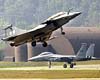 Paris (AFP) Jun 27, 2006
The French airforce took delivery of its first batch of the France-made Rafale fighter plane on Tuesday, with the manufacturer of the long-delayed jet, Dassault Aviation, still looking for the first foreign order for the aircraft. French Prime Minister Dominique de Villepin attended a ceremony at an army base in Saint Dizier, northeast France, where 20 models of the Rafale were delivered. |
|
|

| The content herein, unless otherwise known to be public domain, are Copyright 1995-2006 - SpaceDaily.AFP and UPI Wire Stories are copyright Agence France-Presse and United Press International. ESA PortalReports are copyright European Space Agency. All NASA sourced material is public domain. Additionalcopyrights may apply in whole or part to other bona fide parties. Advertising does not imply endorsement,agreement or approval of any opinions, statements or information provided by SpaceDaily on any Web page published or hosted by SpaceDaily. Privacy Statement |