Energy News  
MOST Space Telescope Plays 'Hide & Seek' With An Exoplanet

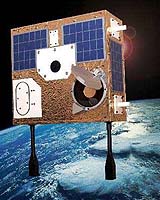
Illustration of MOST in orbit.

Montreal QC (SPX) May 17, 2005
MOST, Canada's first space telescope, has turned up an important clue about the atmosphere and cloud cover of a mysterious planet around another star, by playing a cosmic game of `hide and seek' as that planet moves behind its parent star in its orbit.

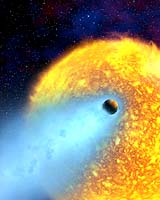
The exoplanet, with a name only an astrophysicist could love, HD209458b (orbiting the star HD209458a), cannot be seen directly in images, so the scientists on the MOST (Microvariability & Oscillations of Stars) Satellite Team have been using their space telescope to look for the dip in light when the planet disappears behind the star.

"We can now say that this puzzling planet is less reflective than the gas giant Jupiter in our own Solar System," MOST Mission Scientist Dr. Jaymie Matthews announced today at the annual meeting of the Canadian Astronomical Society in Montreal.

"This is telling us about the nature of this exoplanet's atmosphere, and even whether it has clouds."

Many of the planets discovered around other stars, known as exoplanets or extrasolar planets, hug surprisingly close to their parent stars; HD209458b orbits at only 1/20th of the Earth-Sun distance (an Astronomical Unit or AU).

It could never support life as we know it. But understanding HD209458b is a key piece in the puzzle of planet formation and evolution that is revising theories of our own Solar System, and estimates of how common are habitable worlds in our Galaxy.

How a giant ball of gas that is larger than the planet Jupiter (which orbits 5 AU from our Sun) got so close to its star, and how its atmosphere responds to the powerful radiation and gravitation fields of that star, are still open questions to exoplanetary scientists.

"The way this planet reflects light back to us from the star is sensitive to its atmospheric composition and temperature," describes Jason Rowe, a Ph.D. student at the University of British Columbia who processed the MOST data.

"HD209458b is reflecting back to us less than 1/10,000th of the total visible light coming directly from the star. That means it reflects less than 30-40% of the light it receives from its star, which already eliminates many possible models for the exoplanetary atmosphere."

By comparison, the planet Jupiter would reflect about 50% of the light in the wavelength range seen by MOST.


Community
Email This Article
Comment On This Article

Related Links
University of British Columbia
Spitzer Space Observatory at Caltech
SpaceDaily
Search SpaceDaily
Subscribe To SpaceDaily Express
Life Beyond Earth
Lands Beyond Beyond - extra solar planets - news and science


Memory Foam Mattress Review
Newsletters :: SpaceDaily :: SpaceWar :: TerraDaily :: Energy Daily
XML Feeds :: Space News :: Earth News :: War News :: Solar Energy News


Latching Onto Lichen
Moffett Field CA (SPX) Dec 06, 2005
Bacteria can often survive the harsh conditions of space, and their toughness and adaptability have made them key candidates for the transfer of life between planets. But in a recent study by European scientists, lichen survived a trip in space even better than bacteria do.

---------------------------------------------------------
New from Telescopes.com!

It's new. And it's downright terrific!

Celestron's CPC Schmidt-Cassegrain telescope is the scope you've been waiting for! It offers new alignment technology, advanced engineering, and bold new design at a new, low price!

In fact, Celestron's Professional Computerized (CPC) scope with revolutionary SkyAlign Alignment Technology redefines everything that amateur astronomers are looking for. It offers quick and simple alignment, GPS technology, unsurpassed optical quality, ease of use, advanced ergonomics, enhanced computerization and, most important, affordability.

Want to view M-31 tonight? One button takes you there!

Shop for telescopes online at Telescopes.com! today!
------------------------------------------------------------


  • Global Wind Map May Provide Better Locations For Wind Farms
  • Downside Risks Loom In The Race For Oil
  • Silicon Solution Could Lead To A Truly Long-Life Battery
  • EU Sees 'No Change' On Nuclear Project Despite French Claim

  • France's Alstom Wins China Nuclear Power Deal
  • Walker's World: Voting For Nukes In Iran
  • Britain May Need Another Generation Of Nuclear Power Plants
  • Study Uncovers Bacteria's Worst Enemy


  • NASA Uses Remotely Piloted Airplane To Monitor Grapes


  • Tiny New Control Device Improves Lateral Stability Of Airplane
  • EADS To Get New Leadership, But Franco-German Rift Leaves Airbus Hanging
  • Boeing Procurement Scandal Spawns 48 Air Force Reviews: General
  • Who Will Win: Boeing Or Airbus?

  • NASA plans to send new robot to Jupiter
  • Los Alamos Hopes To Lead New Era Of Nuclear Space Tranportion With Jovian Mission
  • Boeing Selects Leader for Nuclear Space Systems Program
  • Boeing-Led Team to Study Nuclear-Powered Space Systems

  • The content herein, unless otherwise known to be public domain, are Copyright 1995-2006 - SpaceDaily.AFP and UPI Wire Stories are copyright Agence France-Presse and United Press International. ESA PortalReports are copyright European Space Agency. All NASA sourced material is public domain. Additionalcopyrights may apply in whole or part to other bona fide parties. Advertising does not imply endorsement,agreement or approval of any opinions, statements or information provided by SpaceDaily on any Web page published or hosted by SpaceDaily. Privacy Statement